27% off
Wellness
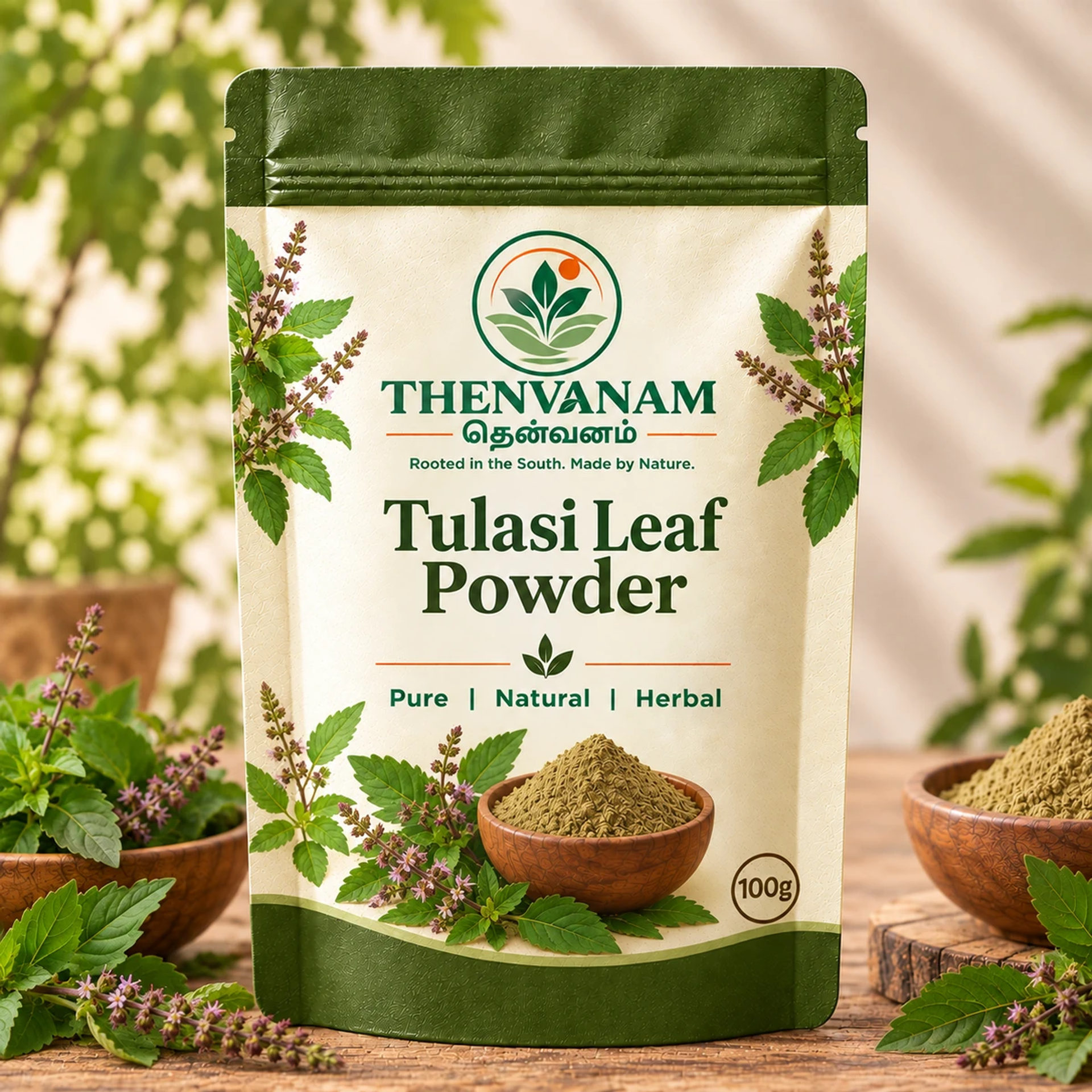
Tulasi Leaf Powder
Single ingredientNo fillers or blendsShips in 7 days
Pure tulasi leaf powder prepared from naturally dried holy basil leaves.
100 g
₹129MRP ₹17927% off

Thulasi (Tamil) · Ocimum tenuiflorum
What is Tulasi?
Tulasi, or holy basil, is Ocimum tenuiflorum. Its leaves are dried and finely powdered into tulasi leaf powder, which has a long-standing place in Indian traditional practices.

Tulasi — holy basil — occupies a particular place in the Indian home, usually a raised plot by the front door. The leaves are dried and finely powdered, keeping the plant available well past its season.
Tulasi has a long-standing place in Indian traditional practices. The powder is used in traditional herbal preparations or combined with a suitable base for external applications.
Most herbs occupy a single shelf in a household — the kitchen rack, the medicine cabinet, the balcony pot. Tulasi has never settled for one. In the same home it is often grown twice: once as an ordinary plant tucked into a courtyard corner, and once again, deliberately, in a raised masonry pedestal by the front door, built and maintained as a small piece of architecture in its own right. That second planting is not incidental. It is the plant treated as a resident of the house rather than a crop grown for it, watered by hand each morning, sometimes before anyone in the family has had their own first cup of tea.
This isn't a case of a useful plant later acquiring some decorative reverence. The religious and the domestic identities of tulasi developed together, each reinforcing the other, and it is worth understanding both a little more closely — not as folklore attached to a spice-rack ingredient, but as a documented, still-practiced set of customs that happen to involve the same leaves this powder is made from.
The raised pedestal built for a tulasi plant has a name of its own: tulasi vrindavana, sometimes shortened locally to tulasi madam or tulasi chaura depending on the region. It is typically a stone or cement structure, often built with small niches or a stepped tower shape, placed either in the central courtyard of older house designs or just outside the main entrance. Where possible, it is oriented to face east, so the plant catches the first sunlight of the day — a placement choice that is practical as much as symbolic, since tulasi does best with strong morning light.
The name vrindavana borrows directly from Vrindavan, the town in Uttar Pradesh associated with Krishna's early life, and the etymological link is intentional: the household altar is a miniature stand-in for that landscape. Married women in many Hindu households traditionally circle the plant and light a lamp at its base in the evening, a small, repeated act that has outlasted a great deal of change in how urban Indian homes are built and lived in. Apartment dwellers without a courtyard often keep the practice alive in a large clay pot on a balcony instead of abandoning it.
Tulasi's ritual calendar has its own set-piece event: Tulasi Vivaha, the ceremonial wedding of the tulasi plant, observed between Prabodhini Ekadashi and Kartik Purnima — roughly the eleventh day to the full moon of the lunar month of Kartika, which usually falls in late October or November. In the ceremony, the tulasi plant stands in for the goddess Tulasi and is formally married to Vishnu, represented either by a Shaligram stone (a fossilized ammonite considered a natural emblem of Vishnu) or by an image of Krishna. Families decorate the plant, string it with a sugarcane canopy, and conduct the full sequence of a Hindu wedding rite in miniature — right down to a priest reciting the marriage mantras.
The ceremony also marks the customary close of the wedding-inauspicious period during Chaturmas and is often treated as the ceremonial start of the Indian wedding season proper. None of this is a private household quirk — it's recorded across temple calendars nationwide, with some of the more elaborate public versions performed at Vishnu temples in Maharashtra and Tamil Nadu. It's a useful example of how thoroughly tulasi is woven into ritual life, well beyond the "grow it for the kitchen" framing a plant like mint or coriander would get.
The Sanskrit tulasī is usually translated as "the incomparable one," built from a root connected to tulā, a weighing scale. The implied image is of a plant that, put on one side of a balance, simply cannot be matched by anything placed on the other — not a claim about its properties, but about its standing. Sanskrit and later devotional literature stack up a small collection of alternate names on the same theme: Vaishnavi ("belonging to Vishnu"), Vishnu-vallabha and Hari-priya (both roughly "beloved of Vishnu"), each one tying the plant's identity to a specific relationship rather than a generic virtue.
This naming pattern is worth flagging because it explains something about how tulasi is discussed even outside religious contexts — the plant is talked about the way you'd talk about a person with a title, not the way you'd talk about an ingredient. That habit of language has survived the shift from temple courtyard to spice-rack tin.
Botanically, tulasi is Ocimum tenuiflorum (the older synonym Ocimum sanctum still appears constantly in literature and product labels, and both refer to the same plant). It sits in the mint family, Lamiaceae, inside a genus — Ocimum — that runs to more than 150 species spread across the tropics and subtropics of Asia and Africa. Within tulasi itself, cultivators and Ayurvedic texts distinguish a few recognisable types. Rama tulsi (also called Sri tulsi) has green leaves and a milder aroma; Krishna tulsi (Shyama tulsi) carries the purple-tinged leaves and stems that give it its name, along with a noticeably sharper scent. A third plant, often sold loosely under the "tulsi" umbrella as Vana tulsi or "wild tulsi," is actually a different species altogether — Ocimum gratissimum — which shows how casually the common name gets stretched across the genus in the marketplace.
Genetic work sequencing the chloroplast genomes of Rama and Krishna tulsi has confirmed they are subtypes of the same species with real, measurable phytochemical differences, not just cosmetic color variants. Researchers studying the genus more broadly note that true tulasi types can be told apart from other Ocimum species by details like yellow (rather than white) pollen and a smaller chromosome count — a fairly technical distinction, but a real one, and a sign that "tulsi" isn't one plant so much as a small cluster of closely related ones.
The genus's wider membership includes the basils most kitchens actually cook with: Ocimum basilicum, sweet or Italian basil, native to regions stretching from Africa to Asia and long established across the Mediterranean; and within that same species, Thai basil, recognisable by its purple square stems and anise-forward scent, which became central to Vietnamese and Thai cooking as basil cultivation spread through Southeast Asia. Sweet basil is generally grown as an annual; Thai basil behaves more like a perennial in warm climates. Tulasi, sweet basil and Thai basil are close enough to be unmistakably related on smell alone — and different enough, botanically and in how each is actually used, that treating them as interchangeable misses the point of all three.
Turning tulasi leaves into a shelf-stable powder is a fairly unglamorous process, and that's rather the point — it's designed to change the leaf as little as possible. Leaves are traditionally harvested in the cooler part of the morning, before flowering sets in and while oil content in the leaf is at its highest, using scissors or a knife rather than tearing by hand to avoid bruising the tissue. They are then dried out of direct sunlight — either spread thin on cloth or a rack in a shaded, well-ventilated spot, or tied into small bundles and hung to air-dry — since direct sun tends to bleach the leaf and drive off its characteristic aroma faster than shade-drying does.
Once the leaves are brittle and fully moisture-free, they're ground down and typically passed through a fine sieve to strip out stem fragments and produce an even, consistent powder rather than a coarse grind. It's a short ingredient list and a short process — leaf, air, time, a grinder — which is precisely why the character of the raw leaf matters so much to how the finished powder turns out.
Dried leaf powders like this one are stable, but not indestructible — moisture, light and air are the three things working against them from the moment the pack is opened. The straightforward approach holds up well here: keep the powder in an airtight container, store it somewhere dry and away from direct sunlight or a stove's ambient heat, and always use a dry spoon when scooping it out, since a wet utensil is the fastest way to introduce moisture that clumps the powder and encourages it to spoil early. A cool, dark cupboard shelf does more for a leaf powder than any amount of packaging design.
A recurring point of confusion is worth restating with a bit more precision than it usually gets: "holy basil" and "basil" are not casual synonyms for the same plant grown in two climates. Ocimum tenuiflorum and Ocimum basilicum are separate species within the same genus, with distinct growth habits, chemistry and culinary roles — closer to the relationship between two different citrus fruits than between "basil grown in India" and "basil grown in Italy."
A second, smaller confusion sits inside tulasi itself: Rama and Krishna tulsi aren't different plants sold under one convenient name — they're two documented cultivars of the same species, distinguished mainly by leaf and stem color and by measurable differences in their oil chemistry, and either can turn up in a dried leaf powder depending on which plants were harvested. Neither is a lesser or "diluted" version of the other; they're simply two recognised faces of the same tulasi.
Unlike most of the leaf and root crops on this site, tulasi has rarely been grown as a field crop in the ordinary agricultural sense across South India — it is, and largely always has been, a dooryard plant, propagated by cutting or seed within the household rather than sourced from a market garden. This has a practical effect on how the dried leaf powder comes together: rather than one large plantation supplying a uniform harvest, tulasi leaf is typically gathered from many smaller plantings, each grown for its own courtyard or shrine, and pooled before drying. It is a domestic crop in the truest sense, closer in scale and character to a herb grown on a windowsill than to a plantation crop like tea or coffee.
That domestic scale is also why tulasi has stayed relatively unmechanised as a crop even as demand for the dried leaf has grown commercially — harvesting is still largely a hand-picking task, done leaf by leaf or sprig by sprig, rather than something suited to large-scale mechanical cutting.
The plant itself is a small, branching shrub, rarely growing past sixty centimetres, with softly hairy stems and leaves that release their characteristic scent readily when brushed against — which is part of why a tulasi vrindavana placed near a doorway or courtyard path does double duty, releasing fragrance each time someone passes close enough to touch it, independent of any ritual watering or lamp-lighting.
Flowering happens in small, elongated spikes of tiny purple or white blossoms, arranged in whorls up a slender stalk that rises above the leaves — a detail easy to miss on a plant grown mainly for its leaf, since most households pick leaves for drying well before the plant reaches full bloom.
Yes — tulasi is the Indian name for holy basil, Ocimum tenuiflorum.
No. Sweet basil used in Italian cooking is Ocimum basilicum, a different species from tulasi.
Botanical nomenclature and regional plant names — THENVANAM Editorial
Botanical names are given in the accepted binomial form; Tamil and other regional names are recorded as they are used in South Indian households.
Documented South Indian household practice — THENVANAM Editorial
Descriptions of traditional use record how an ingredient has customarily been prepared and used. They are not statements of clinical effect and should not be read as health advice.
Wellness
Single ingredientNo fillers or blendsShips in 7 days
Pure tulasi leaf powder prepared from naturally dried holy basil leaves.
100 g