
29% off
Hair & Skin Care
Neem Leaf Powder
Single ingredientNo fillers or blendsShips in 7 days
Pure dried neem leaf powder for traditional skin and personal-care preparations.
100 g
₹119MRP ₹16929% off

Vembu (Tamil) · Azadirachta indica
What is Neem?
Neem is the leaf of Azadirachta indica, called vembu in Tamil. The dried leaves are finely ground into neem leaf powder, used in traditional skin and personal-care preparations.

Neem is one of the most recognisable trees in South India, lining roadsides and temple grounds. Its bitter leaves are dried and ground into a fine green powder with a long history in traditional Indian personal-care practices.
Neem has a long history in traditional Indian personal-care practices. The powder is mixed with water or a suitable natural base into a face or body pack.
Drive through almost any town in Tamil Nadu and you will pass a neem tree before you pass a traffic signal. It grows along canal banks, outside ration shops, in school compounds, at bus stands where its shade is the only shade for a hundred metres. Botanists classify it more narrowly than its ubiquity suggests: Azadirachta indica belongs to the family Meliaceae, the mahogany family, in the order Sapindales, sharing kinship with true mahoganies and the chinaberry tree rather than with any of India's more storied ritual trees. Kew's Plants of the World Online traces its confirmed native range to a surprisingly compact belt — Assam eastward through Myanmar, Thailand, Laos, Cambodia and Vietnam — even though the tree has grown across the Indian subcontinent for so many centuries that it reads, to most people, as native everywhere it stands.
That discrepancy is worth sitting with for a moment. Neem did not arrive in peninsular India recently, nor did it arrive by accident. It was carried, planted and favoured, spreading with human settlement until it became one of those species — like the coconut palm or the tamarind — that a place claims as its own regardless of where its ancestors first took root. It is an evergreen, fast-growing tree that tolerates poor, dry soil and does not ask much of the ground it is given, which is part of why it ended up lining so many roadsides rather than confined to gardens.
A neem tree at a temple gate is rarely there by chance. Village shrines across India are commonly built around a single tree — a banyan, a bodhi fig, or a neem — and the tree itself becomes part of the sacred geography, not merely decoration around it. Neem in particular is linked to the goddess Sitala, worshipped for her connection to fever and the well-being of children, and in many regions a special puja is offered to the neem tree during Chaitra Navaratri. Its leaves also appear in the iconography and worship associated with Durga and Mahakali in parts of the country.
The tree's ritual calendar has a bitter-sweet high point each spring. In Andhra and Telangana, Ugadi is marked by ugadi pachadi, a preparation that deliberately mixes neem flowers with jaggery, tamarind, raw mango, salt and chilli — sweet, bitter, sour, salty and hot in a single spoonful. A fortnight later, Puthandu, the Tamil New Year, carries a close cousin of the same custom, with neem flowers and raw mango playing a similar symbolic role. The idea behind the dish is explicitly stated in how it is served and spoken about at the table: life in the coming year will bring both what is pleasant and what is not, and the meal asks you to taste both without flinching. It is worth being precise about what this is and is not — it is a documented seasonal food custom, tied to a specific festival and a specific recipe, not a claim about what eating neem does for the body.
Ask anyone who grew up near a neem tree what it tastes like and you get the same wince before the answer. Neem's bitterness is not a mild, coffee-adjacent bitterness — it is assertive, lingering, the kind that Telugu and Tamil cooking traditions treat as a flavour worth including on purpose rather than a flaw to mask. That is unusual. Most cuisines build recipes around avoiding bitterness; the neem-flower dishes of the Telugu and Tamil New Year build a recipe specifically to include it, alongside sour, sweet, salty and hot, as one of the required tastes of a complete dish.
This is also why neem sits in an odd cultural slot compared to, say, curry leaf or moringa — leaves that Indian households cook with routinely. Neem leaf is not really a food ingredient in daily use; its bitterness is too forward for that. It belongs instead to a smaller category of Indian plant material — bitter gourd is the other well-known member — that is valued precisely because it is unpalatable in the ordinary sense, and is worked into specific customs rather than into everyday cooking.
The path from tree to tin is simple in principle and exacting in practice. Mature, unblemished leaves are picked, washed to remove dust and any residue, and the stems are separated out before drying. Drying method matters more than it might seem to from the outside: leaves spread thin and dried in shade, rather than flash-dried under direct sun or in high heat, tend to keep their deep green colour and dry to a crisp rather than a scorched brown. Sun-baked or over-heated leaves discolour and can turn brittle in an uneven way that shows up immediately once the leaf is ground.
Once the leaves are dry enough to crumble between the fingers, they are milled — traditionally by stone grinding, commercially by blade or hammer mill — into the fine, slightly grey-green powder that ends up in a 100g pack. The finer the grind, the more evenly the powder disperses when it is later mixed into a paste, which is one reason processors sieve the milled leaf rather than stopping at the first pass through the grinder.
Long before dried botanical powders were sold in resealable pouches, Indian households were grinding leaves and barks at home and mixing them into pastes on a stone or in a bowl. Neem leaf occupies a specific, long-standing slot in that home tradition — usually blended with water, or with another base a family already kept on hand, into a paste applied to the face or body as part of a personal-care routine passed down rather than read off a label. The practice is old enough that it predates any of the packaging, branding or marketing language that now surrounds botanical powders, and it has persisted largely unchanged: leaf powder, a liquid base, a bowl, a few minutes.
What makes neem distinct within this broader tradition of leaf and herb pastes — hibiscus, henna, multani mitti, and so on — is less about method and more about identity. Where a henna paste is chosen for colour and a hibiscus paste for its place in hair-care custom, neem's reputation in this space rests on its sheer familiarity: nearly every household making these pastes at home had a neem tree within reach, which is as much a story about the tree's ubiquity as about the practice itself.
Search for neem online and you will run into a second, entirely different neem industry — one built around neem oil, pressed from the tree's seeds rather than its leaves, and used as an ingredient in organic pest-management products. Azadirachtin, a compound concentrated in neem seed oil, has been studied as a botanical pesticide for decades and is registered for use against a long list of crop pests; agricultural extension services and pesticide regulators publish detailed guidance on it. This is a genuine, well-documented industrial and agricultural use of the neem tree.
It is also a completely different product, from a different part of the tree, made for a different purpose, than a dried leaf powder sold for personal-care paste-making. The overlap in the plant's name causes a lot of the confusion: because "neem" shows up constantly in gardening forums and organic-farming articles talking about seed-derived oil and azadirachtin, it is easy to assume that a leaf powder carries the same properties or is meant for the same job. It is not the same material, and this leaf powder makes no claim, implicit or explicit, about pest control, insect activity, or any effect on the skin or body — it is simply dried, ground Azadirachta indica leaf, sold for the same paste-making tradition described above.
Dried leaf powders are, by nature, thirsty for moisture and sensitive to light and heat — three things a Tamil Nadu kitchen or bathroom shelf has no shortage of. Store the pack sealed and upright in a cool, dry spot away from direct sunlight and away from the stove or any other source of ambient heat and steam. Once opened, reseal it tightly after each use and always use a dry spoon; a wet spoon dipped into the tin is the single most common way a fine leaf powder ends up clumping or developing an off smell well before it otherwise would. An airtight container — glass or food-grade plastic with a snug lid — is a reasonable step up from the pack it arrives in, particularly in humid months.
Colour is a decent, low-effort indicator of how a batch has held up. Fresh neem leaf powder reads as a matte, deep green-grey; if a portion has gone patchy, notably paler, or has picked up a musty smell distinct from its usual sharp bitterness, that batch is past its useful window and is best set aside rather than mixed into a paste.
The English word "neem" is a fairly recent traveller, borrowed from Hindi-Urdu nīm, which in turn descends from the Sanskrit nimba. Tamil takes a slightly different, older-sounding route to the same tree: vembu, a name close enough to the Sanskrit root that linguists treat the two as cognates rather than coincidences, and one still heard in everyday Tamil Nadu speech far more often than any Sanskritised alternative. Other regional names branch off from the same idea — veppu in Malayalam, turakabevu in Kannada, kaidavepu in Telugu — a small, quiet map of how one tree spread its name alongside its shade across the peninsula.
Colonial-era English also gave neem two names that have mostly fallen out of everyday use but still turn up in older texts and nursery catalogues: "Indian lilac," a nod to its lilac-like flower clusters despite neem having no real botanical kinship with true lilacs, and "margosa," a name whose own origins are murkier and disputed among etymologists. Neither name caught on the way "neem" eventually did, and today the tree is close to unique among common Indian plants in having its vernacular Hindi-Urdu name, rather than a Sanskrit, Tamil or English one, serve as its standard reference across the country and internationally.
Part of why neem is so easy to find is how little it demands of the ground it grows in. It establishes quickly from seed, tolerates poor and even saline soils that would stunt many other trees, and copes with long dry spells better than most of the shade trees planted alongside it on Indian roadsides. Left unpruned it can reach fifteen to twenty metres, with a broad, rounded crown dense enough to drop the temperature noticeably underneath it on a hot afternoon — one of the plainer, more practical reasons it was planted so widely along streets and around public buildings in the first place, independent of any of its cultural or ritual associations.
The tree also fruits prolifically, producing small, olive-like drupes that ripen from green to yellow. Birds and bats disperse the seeds widely, which is part of why neem has naturalised so readily wherever it has been introduced outside India, from parts of Africa to the Caribbean — a hardy, self-propagating tree wherever it lands, much like the roadside stands it is best known for at home.
The leaves themselves are compound, made up of eight to nineteen narrow, saw-edged leaflets arranged along a central stalk, giving the canopy the same feathery texture common to several of the pinnate-leaved trees in this range. A neem tree in flower is briefly fragrant, covered in small, star-shaped white blossoms that draw enough bees to make neem honey a distinct, recognisable product in its own right in parts of India where the trees grow densely enough.
Vembu.
Yes — perform a patch test before topical use.
Botanical nomenclature and regional plant names — THENVANAM Editorial
Botanical names are given in the accepted binomial form; Tamil and other regional names are recorded as they are used in South Indian households.
Documented South Indian household practice — THENVANAM Editorial
Descriptions of traditional use record how an ingredient has customarily been prepared and used. They are not statements of clinical effect and should not be read as health advice.
Hair & Skin Care
Single ingredientNo fillers or blendsShips in 7 days
Pure dried neem leaf powder for traditional skin and personal-care preparations.
100 g

Every traditional pack recipe ends the same way — "mix with a suitable natural base". Which base you choose changes the consistency, the drying time and how the pack comes off.
5 min read
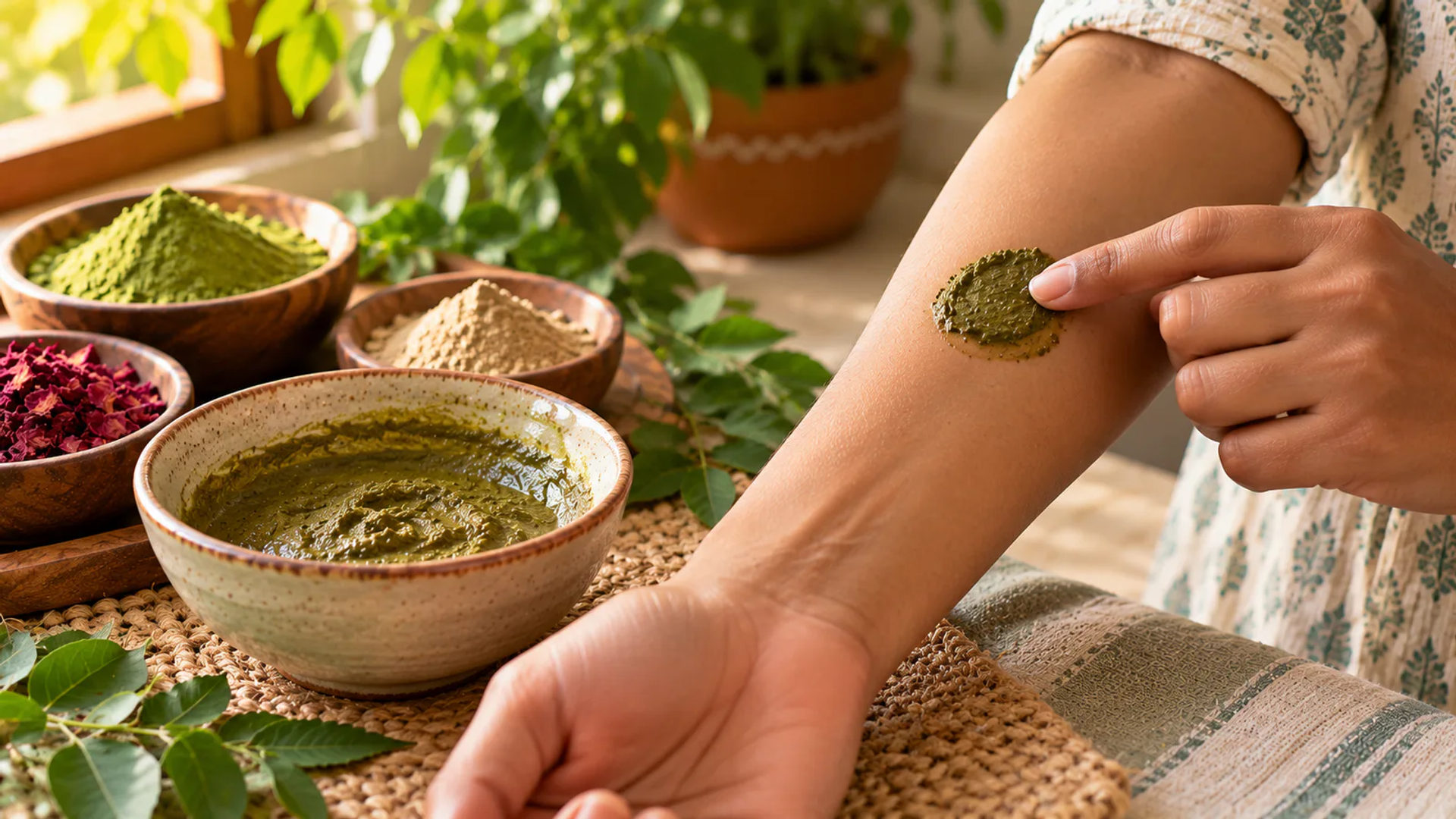
Four steps, done once per powder. The reason single-ingredient powders are worth buying is the same reason a patch test is straightforward.
4 min read
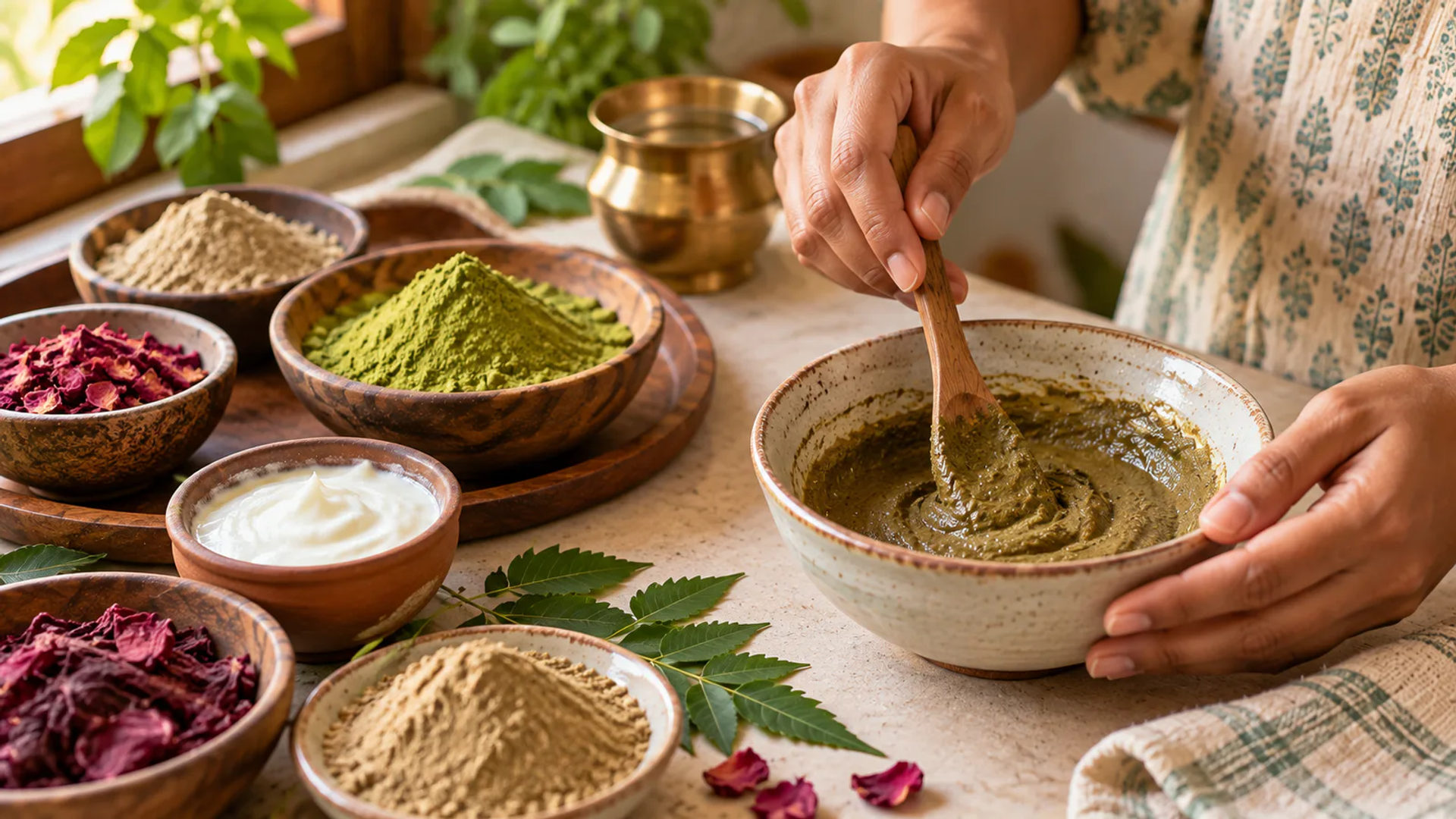
Rose petal, a base and a patch test. The five steps that turn a jar of powder into a pack you can actually use.
5 min read

The phrase appears on almost every natural-products label. Here is the specific thing it means on a THENVANAM pack, and what it does not mean.
4 min read