
28% off
Traditional Herbal
Vettiver Powder
Single ingredientNo fillers or blendsShips in 7 days
Traditional vettiver root powder made from carefully dried vetiver roots.
100 g
₹179MRP ₹24928% off

Vettiver (Tamil) · Chrysopogon zizanioides
What is Vettiver?
Vettiver is the root of the grass Chrysopogon zizanioides. The dried root is finely ground into vettiver powder, traditionally valued in South Indian natural bathing and personal-care practices.

Vettiver is a tall grass whose value lies entirely underground. The dense, fragrant root system is dug, dried and ground — the same root that is woven into window screens to cool a house in the Tamil summer.
Vetiver is traditionally valued in South Indian natural bathing and personal-care practices. The powder is mixed with a suitable natural bathing or body-care base.
Most grasses are grown for the part that shows. Vettiver is grown for the part that doesn't. Above the soil it is an unremarkable tufted grass, waist-high, olive-green, easy to walk past without a second glance. Below the soil is where the plant does something almost no other grass does: instead of sending roots outward in a shallow mat the way lawn grass or most cereal crops do, vetiver sends its roots straight down. Field studies on Chrysopogon zizanioides have recorded root systems reaching two to four metres in depth, with some measurements exceeding four metres in favourable soil, and growth rates of roughly 30 centimetres a month in the first season alone. The result is a root mass shaped less like a spreading net and more like an inverted "U" or a dense vertical curtain hanging beneath the grass row.
This one structural fact is the reason vetiver shows up in such unrelated corners of the world: as a curtain hung wet across a doorway in Thanjavur, as a hedge holding a hillside together in Karnataka or Laos, and as a base note anchoring a perfume bottle in Grasse. All three depend on the same root, and none of them are the same use.
For most of the twentieth century the plant was catalogued as Vetiveria zizanioides. Older textbooks, oil-trade documents, and even a fair number of current product labels still carry that name, and it isn't wrong exactly — it's superseded. Taxonomists working through the grass family Poaceae found that the features once used to separate the genus Vetiveria from the much larger genus Chrysopogon didn't hold up under closer scrutiny; the two groups weren't distinct enough to justify separate genera. Because the name Chrysopogon was published earlier in the botanical literature, the rules of botanical nomenclature require the older name to take priority once the genera are merged. So the plant was moved, and the accepted name recognised by Kew's Plants of the World Online today is Chrysopogon zizanioides (L.) Roberty, with Vetiveria zizanioides retained as a synonym rather than a rival name.
It's a reminder that plant names are not fixed labels handed down from antiquity — they are a live, working classification system, periodically revised as botanists compare floral structures, genetics, and lineage more carefully. Vetiver has in fact carried a small crowd of names over the last two centuries, at various points filed under Andropogon, Anatherum, and Sorghum before settling where it is now. The species itself, of course, never noticed any of this.
Take that deep, downward root system and put it on a slope, and you get a low-tech but serious piece of civil engineering. Vetiver hedgerows are planted along contour lines on erosion-prone land across South and Southeast Asia, sub-Saharan Africa, and Latin America — a practice formalised under what agricultural engineers call the Vetiver System. Because the roots plunge down rather than spreading out, a vetiver hedge doesn't compete with an adjacent crop for water or nutrients the way a spreading-rooted plant would; instead it forms something closer to a living retaining wall a few centimetres wide, physically binding the soil profile in place while the above-ground tufts slow surface run-off and trap sediment washing down the slope. Individual roots are fine, often well under a millimetre in diameter, yet tests on their tensile strength have put the finer roots in the same range as some steel-reinforcement standards — a genuinely unusual property for a plant root, and part of why highway departments and watershed-management programmes across the tropics have planted vetiver hedges by the kilometre.
Put the same root somewhere else entirely — a copper alembic in the Nord department of Haiti, a stainless-steel still in Java, a distillery on Réunion — and it becomes the raw material for one of the most important ingredients in global perfumery. Vetiver root is steam-distilled into an essential oil that perfumers prize as a base note: heavy, slow to evaporate, and used less to smell of anything in particular than to hold an entire composition together over the hours a fragrance is worn. The oil itself is a genuinely complex substance, made up of more than a hundred and fifty distinct sesquiterpene compounds, and its character shifts noticeably by origin — Haitian vetiver oil is usually described as clean and slightly smoky, Javanese vetiver as smokier and more earthen, Bourbon vetiver from Réunion as mineral and nutty. Haiti and Indonesia between them account for most of the world's supply; India, Brazil, and a handful of other tropical producers make up the rest. None of this touches the bathing-powder tradition this pack belongs to — it's simply the same root, harvested from the same kind of plant, put to an entirely different trade an ocean away.
Long before the window air conditioner, houses and government offices across the Tamil summer relied on a much simpler mechanism, and it's worth describing exactly how it works. A tightly woven mat of vetiver root — called a khus tatti in much of North India and known by regional names elsewhere — is hung across an open doorway or window and wetted with water, either splashed on by hand or dripped from a line above. As outside air is pulled or blown through the damp, fibrous mat, water on the root surface evaporates, and evaporation draws heat out of the air passing through it. This is ordinary evaporative cooling — the same physical process behind a wet cloth over a clay pot or a desert cooler — with the vetiver mat simply providing an unusually large, absorbent surface area of root fibre for the water to evaporate from. Measurements taken on dry, breezy days have recorded the air on the far side of a wetted khus screen running several degrees Celsius cooler than the air going in.
It's a fact about airflow and evaporation, not a property of the plant beyond that: the root mat is doing exactly what any sufficiently porous, water-absorbing material hung in a draught would do, and it happens to be vetiver root that has served this purpose across the subcontinent for generations, in part because the same dense weave that makes the root useful underground for erosion control makes it useful as a screen above ground. The screens carry a scent too — vetiver root gives off its familiar earthy, slightly smoky smell more strongly once wet — which is a large part of why the tradition has stayed associated with the arrival of the hot season in South Indian memory, distinct from and older than any bathing-powder use of the same root.
Every part of how vetiver root becomes a jar of powder is shaped by the fact that it is, in the end, a root, and roots are simply harder to get out of the ground than leaves or flowers are. Harvesting means loosening a metre or more of dense, wiry, deeply anchored root mass from the soil — traditionally by hand with a spade or mattock, sometimes assisted by a plough pass first to break the ground, but never a matter of simply cutting a stem. The root mat has to be dug up largely intact, then separated from the crown of the plant, and the fine, hair-like feeder roots teased out and cleaned of adhering soil, usually by repeated washing and beating.
This is also, in fact, exactly where the plant's name comes from: the Tamil vetti-ver — vetti, "to cut or dig," and ver, "root" — describes precisely this act, digging the root up, rather than describing the plant's appearance or scent the way many botanical names do. It travelled into French as vétyver and from there into English as vetiver sometime in the mid-nineteenth century. Once dug and washed, the root is dried — traditionally in the shade or under filtered sun, since direct harsh heat can drive off the aromatic compounds the root is valued for — before being ground down into the fine powder sold as THENVANAM Vettiver Powder. Compared with harvesting a leaf crop, where a sickle and a drying mat are most of the equipment needed, root harvesting is slower, more physically demanding, and yields a proportionally smaller amount of usable material per plant, which is part of why root powders generally sit at a different price point than leaf or flower powders from the same family of plants.
Vettiver powder is a dried, ground plant material, and it behaves like one. Moisture is the main thing working against it: a root powder that picks up ambient humidity will clump, lose the sharp edge of its aroma, and become more hospitable to mould over time. Keep it in an airtight container — glass or food-grade plastic with a tight seal both work — rather than left open in the pack it arrived in. Store it somewhere cool, dry, and out of direct sunlight; a kitchen cupboard away from the stove and a sink is generally better than a shelf near a window. A dry spoon, used only for this jar, is worth the small discipline it takes, since introducing any moisture into the container is the single most common way a good batch of root powder turns patchy or musty before its time.
People who've never handled all three tend to lump vetiver, lemongrass, and citronella grass together, and the confusion is understandable — all three are aromatic grasses from tropical Asia that have found their way into everyday household use. But they are not close relatives, and knowing where they differ is useful.
THENVANAM's Vettiver Powder is the root — dug, washed, dried, and ground — sold plainly as that and nothing more. It sits at the meeting point of three unrelated stories: an engineering material strong enough to be measured for tensile strength, a raw material shipped to distilleries on the far side of the world for one of perfumery's oldest base notes, and a household material that has cooled Tamil homes and found its way into South Indian bathing practice for longer than anyone selling it today can trace precisely. The powder itself makes no claims beyond being what it is: one root, ground fine, from a grass that happens to grow in the one direction almost no other grass does.
The root. It is dried and finely ground.
Yes — vettiver is the Tamil spelling of vetiver, Chrysopogon zizanioides.
Botanical nomenclature and regional plant names — THENVANAM Editorial
Botanical names are given in the accepted binomial form; Tamil and other regional names are recorded as they are used in South Indian households.
Documented South Indian household practice — THENVANAM Editorial
Descriptions of traditional use record how an ingredient has customarily been prepared and used. They are not statements of clinical effect and should not be read as health advice.
Traditional Herbal
Single ingredientNo fillers or blendsShips in 7 days
Traditional vettiver root powder made from carefully dried vetiver roots.
100 g
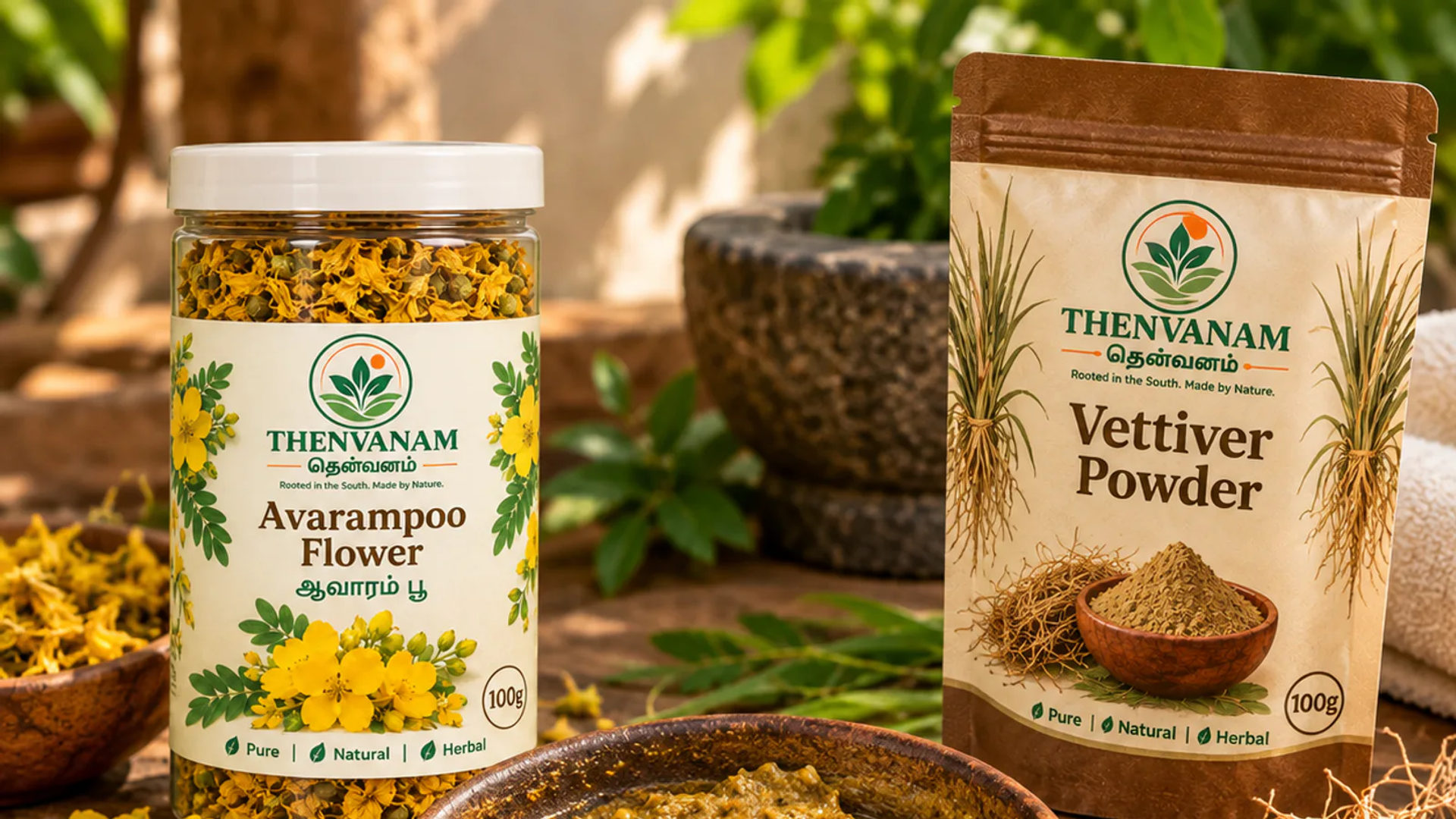
A whole dried flower and a root powder, brought together fresh — the closest thing in the range to a traditional Tamil bath preparation.
3 min read

Between the plant and the pack there are two steps that decide almost everything about the finished powder. Neither is complicated. Both are easy to get wrong.
5 min read

Where the name came from, and why a business selling twelve botanicals bothers to write about plants at all.
5 min read