
25% off
Traditional Herbal
Avarampoo Flower
Single ingredientNo fillers or blendsShips in 7 days
Whole dried Avarampoo (Senna auriculata) flowers, unground.
100 g
₹149MRP ₹19925% off

Avarampoo (Tamil) · Senna auriculata
What is Avarampoo?
Avarampoo is the Tamil name for the flower of Senna auriculata, also called avaram senna. The whole dried flowers are used in traditional bath and beauty preparations, typically boiled in water first.

Avarampoo is the bright yellow flower of Senna auriculata, a shrub of dry Tamil Nadu scrubland. It is one of the most distinctly South Indian ingredients in the range — a flower with no widely used English name, only its own.
Avarampoo has traditionally been used in natural bath and beauty preparations. The whole dried flowers are boiled in water, then that water is mixed with gram flour or another suitable natural base.
Senna auriculata is not a plant that asks for much. It grows as a much-branched shrub, rarely taller than a person, with smooth cinnamon-brown bark and branchlets covered in a fine down. Botanically it sits in the family Fabaceae, subfamily Caesalpinioideae, and for a long stretch of the twentieth century it was filed under a different name entirely: Cassia auriculata, the name that still turns up on older herbarium sheets and in most of the popular literature written about it. Kew's Plants of the World Online now lists Cassia auriculata as a synonym, with Senna auriculata (L.) Roxb. as the accepted name, but both refer to the same plant.
Its native range runs from the Indian subcontinent into Myanmar, and within that range it has a strong preference: dry, scrubby, thorn-forest country. In Sri Lanka it is described as common along the sea coast and through the dry zone. In India it is a fixture of the Deccan's rain-shadow tracts — the red-soil, low-rainfall belts of Tamil Nadu, Andhra Pradesh, Telangana and Karnataka where taller trees struggle and scrub takes over. It is drought-tolerant in the unglamorous sense: it survives where little else volunteers to, coppicing back readily after cutting and holding its ground on degraded and eroded land. Telangana has made it the state flower, where it is known as tangedu.
The leaves are compound, each one made up of sixteen to twenty-four small leaflets a couple of centimetres long, giving the shrub a fine, feathery look even in the driest months. The flowers, by contrast, are anything but modest — bright yellow, nearly five centimetres across, held in short, erect clusters at the branch tips, blooming roughly from January through April after the winter rains. The seed pods that follow are flat, seven to eleven centimetres long, each holding twelve to twenty seeds in its own separate compartment, a small architectural detail typical of the genus.
It is worth separating, clearly and early, two traditional uses of Senna auriculata that get run together in casual writing about it — because they draw on entirely different parts of the plant and belong to entirely different economies.
The bark is the older commercial story. For much of southern India's pre-industrial and early-industrial history, avaram bark was one of the principal native sources of tannin used to convert raw hide into leather. Bark from plants over about three years old carries a tannin content in the range of 15 to 24 percent by dry weight, high enough that avaram was harvested at real scale around Madras, Hyderabad and Mysore, usually through coppicing — cutting the shrub back and letting it regrow bark for the next cycle rather than felling it outright. Tanners used it on heavy hides as well as goat and sheep skins, producing a buff-coloured leather that darkened toward black-red without further finishing. In the Madras Presidency, leatherwork built on avaram-tanned hide was closely associated with the Chakkiliyar community, who turned it into footwear, saddlery and agricultural equipment. A 2025 study in the journal South Asia, tracing the vegetable-tanning trade between 1914 and 1934, documents how colonial industrial policy tried to formalise and extract value from exactly this kind of artisanal tanbark knowledge — before industrial chrome tanning displaced bark-tanning almost entirely over the following decades, pushing many of those same artisans into unrelated wage labour.
The flower is a separate, domestic tradition, and the one THENVANAM's Avarampoo actually belongs to. Nothing about the flower's traditional use touches tanning or leather at all — it comes out of bath and beauty preparation, a household practice rather than a trade. The two uses share only a common shrub; the bark went to tanneries, the flower stayed in the home.
Avarampoo is a compound of two Tamil words: avaram (ஆவரம்), the plant's own name — sometimes rendered aavaarai (ஆவாரை) in its fuller form — and poo (பூ), simply "flower." Put together, the name says exactly what it is: the flower of the avaram plant, nothing more poetic than that.
What it does not have is a settled English equivalent. "Avaram senna" and "tanner's cassia" show up in English-language product listings and reference works, but neither is a common name in the way "turmeric" or "neem" are common names — they are descriptive tags built around the Tamil word itself, or around the plant's tanning-industry role rather than the flower. Compare this to a plant like Hibiscus rosa-sinensis, which English speakers happily call "hibiscus" without needing to know any of its dozen regional names. Avarampoo never made that crossing. It stayed a plant known by its own name, in its own language, because its use never travelled far outside the region where that language is spoken. That is worth sitting with rather than smoothing over: some ingredients are regional not because they are obscure, but because their whole traditional context — dry scrubland, a particular bathing custom, a particular vocabulary — is regional too.
The flowers are picked while fresh, typically in the cooler hours of the morning when they have just opened, and the accepted method for drying them is shade-drying rather than direct sun. Sun-drying is faster but tends to bleach or dull the bright yellow of the petals and can degrade them unevenly; shade-drying, spread thin and turned over a few days, keeps the colour intact and dries the flowers more gently all the way through. This is a small but real point of craft — a batch of avarampoo that has gone pale grey-yellow rather than staying gold is usually a batch that was dried too fast, in too much sun.
Once fully dry, the whole flowers are brittle, light, and should hold their shape rather than crumble to dust in the hand. THENVANAM sells the flower in exactly this whole, dried form — a deliberate change from the powder the product used to be sold as, and one that matters for how the flower behaves once it reaches a bowl of water.
Most of the single-ingredient powders in a bath-and-beauty range work the same simple way: a spoonful of dry powder goes into water or another liquid base, is stirred, and is used more or less immediately. Avarampoo does not work that way, and the difference comes down to what a whole dried flower actually is compared to a ground powder.
A powder has already had its cell structure broken open by grinding — water gets in easily, quickly, at room temperature. A whole dried flower has not. Its petals and floral parts are still intact, held together by their own fibre, and simply soaking a whole flower in cold water releases very little of what is inside it in any useful time frame. Traditional practice deals with this by boiling: the whole dried flowers go into water, which is brought up to heat and simmered, and only that resulting water — coloured, and carrying what the boiling has drawn out of the flower — is then mixed with gram flour or another suitable base to form a paste. The boiling step is doing the same job that grinding does for other ingredients, just with heat and time instead of mechanical force.
This is also, incidentally, the practical logic behind selling the flower whole rather than pre-ground. A powder invites shortcuts — straight into water, no boiling — that skip the step the ingredient actually depends on. Selling the whole flower keeps the traditional two-stage method intact: boil first, then mix.
Dried botanicals are, in general, unfussy about storage as long as three basic conditions are met: kept dry, kept sealed, and kept out of direct light. An airtight container — glass or a similarly sealed jar rather than an open bag — is the standard recommendation across dried-herb and dried-flower handling generally, and it applies here without any special exception. Moisture is the main risk with a whole flower like this: humidity re-introduced into a dried petal can encourage mould or simply soften and dull the flower well before it is used. Light and heat matter less urgently but still contribute to colour fading over time, which is why a cupboard or drawer beats a sunny windowsill for anything dried and stored for later use.
There is no reliable, independently documented shelf-life figure worth quoting for dried avarampoo specifically, and any number offered without a real basis would be exactly that — a made-up number. The safer and more honest guidance is behavioural: store it dry, sealed, and dark, and judge the flower by how it looks and smells over time rather than by a printed date.
A handful of confusions come up often enough with this flower that they are worth addressing directly.
The first is a mix-up with the golden shower tree, Cassia fistula, a much larger tree with long hanging chains of yellow flowers that is common as an ornamental across South and Southeast Asia and blooms mainly as the hot season sets in. Senna auriculata is a modest shrub, not a tree, its flowers sit in short upright clusters rather than long pendant chains, and it flowers earlier in the year, generally from January into April, following the winter rains rather than ahead of the summer heat. The resemblance is real — both are bright yellow, both are in the same broad plant family — but the two are not interchangeable, and older texts sometimes lump them together under loose vernacular names.
The second concerns the change from powder to whole flower described above: some returning customers expect the pre-ground product they may have bought before and are unsure what to do with a bag of intact dried flowers. The answer is the boiling method described in the previous section — it is not an inconvenience introduced by selling the whole flower, it is the traditional method that a powder had, in effect, been shortcutting.
The third is the assumption that "avaram senna" being in the same genus as the senna used in over-the-counter laxative products means the flower behaves the same way domestically. Taxonomic relatedness within a genus is not equivalence of traditional use — avaram bark and avaram flower have their own distinct, separately documented histories, described above, and neither corresponds to the commercial senna-leaf products sold elsewhere under a similar-sounding name.
Senna auriculata's tolerance for degraded, eroded, low-rainfall ground is not incidental to how it has been managed. Coppicing — cutting a shrub back hard and letting it regrow from the base rather than replacing the plant — works well on Senna auriculata precisely because it recovers readily from cut stems, the same trait that let generations of bark harvesters return to the same plants year after year rather than clearing and replanting scrubland each cycle. Flower harvest for THENVANAM's product does not require cutting the shrub at all; only the blooms are picked, leaving the plant to flower again the following season.
This resilience is also why Senna auriculata shows up in land-restoration and afforestation plantings across the same dry, red-soil belts it grows in naturally — a shrub already suited to the ground it is being asked to help stabilise, rather than an introduced species needing extra care to establish.
There is no common English name for the flower itself. The plant is called avaram senna, botanically Senna auriculata.
Water, gram flour or another suitable natural base.
Botanical nomenclature and regional plant names — THENVANAM Editorial
Botanical names are given in the accepted binomial form; Tamil and other regional names are recorded as they are used in South Indian households.
Documented South Indian household practice — THENVANAM Editorial
Descriptions of traditional use record how an ingredient has customarily been prepared and used. They are not statements of clinical effect and should not be read as health advice.
Traditional Herbal
Single ingredientNo fillers or blendsShips in 7 days
Whole dried Avarampoo (Senna auriculata) flowers, unground.
100 g
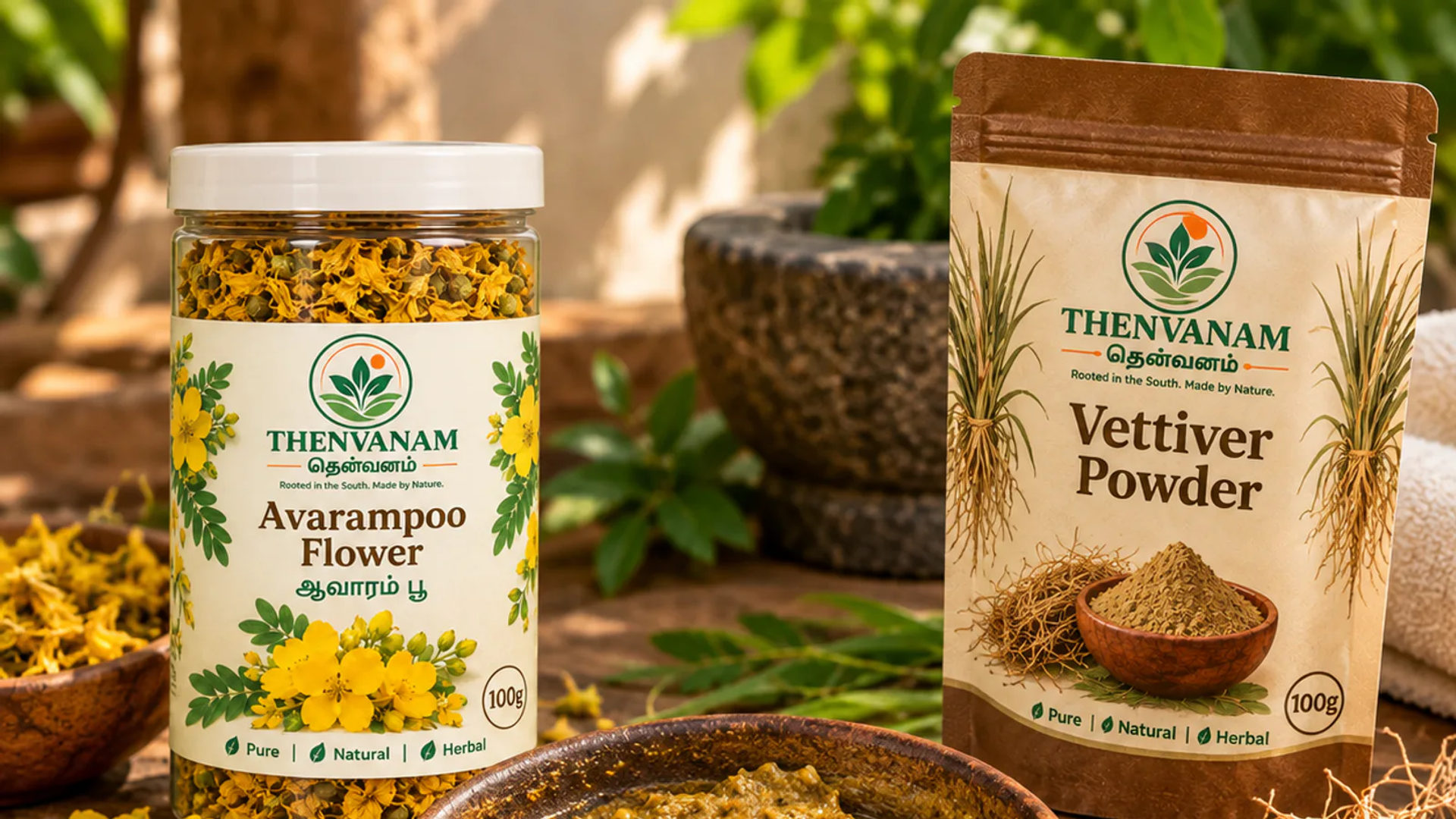
A whole dried flower and a root powder, brought together fresh — the closest thing in the range to a traditional Tamil bath preparation.
3 min read
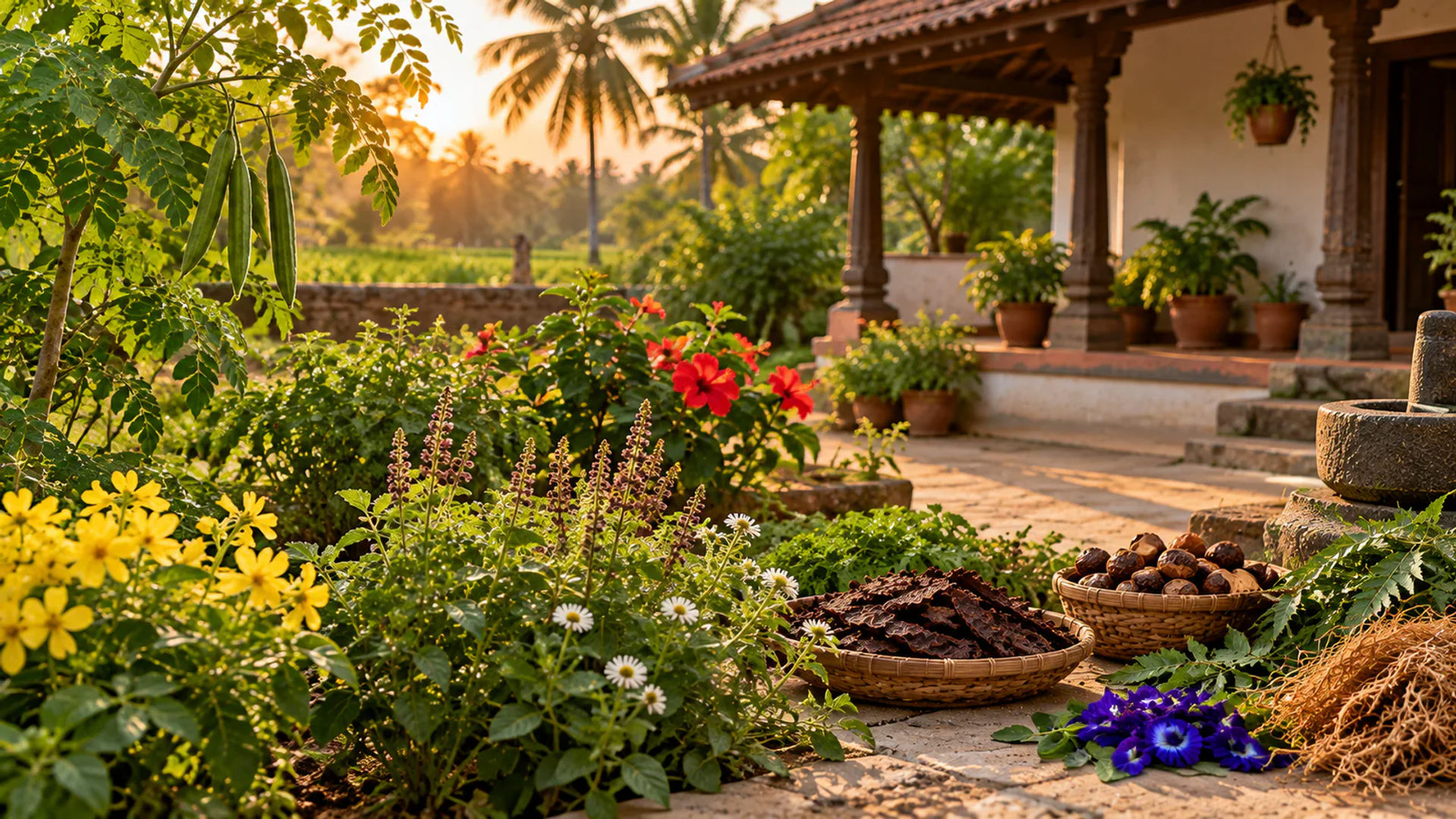
Where the name came from, and why a business selling twelve botanicals bothers to write about plants at all.
5 min read