
26% off
Skin Care & Beauty
Rose Petal Powder
Single ingredientNo fillers or blendsShips in 7 days
Finely powdered dried rose petals for traditional natural beauty preparations.
100 g
₹169MRP ₹22926% off

Roja (Tamil) · Rosa species
What is Rose?
Rose petal powder is made from carefully dried rose petals, finely milled. Its fine texture makes it suitable for traditional face and body preparations.

Rose petals are dried and milled into one of the softest powders in the range. The texture is what matters here — fine enough to spread smoothly across skin without grit.
Dried rose petals have a long-standing place in traditional Indian beauty preparations. The powder is mixed with water, aloe vera gel, yogurt or another suitable natural base and applied as a pack.
Walk through a flower market in Madurai or Chennai before dawn and you will see roses sold by the kilogram, strung into garlands alongside jasmine for weddings, temple offerings, and the small daily ritual of decorating a car dashboard or a doorway. Drive instead through the Ganges plain near Kannauj in Uttar Pradesh during the short rose-harvest window of February and March, and you will find roses grown for an entirely different purpose: distillation into attar and rose water, a trade that has run in that district for centuries. Neither of these is quite the same crop, grown the same way, as the roses that end up dried and milled into a fine, fragrant powder.
It is easy to assume "rose" is a single, interchangeable ingredient because the flower looks similar wherever it is sold. In practice, India runs at least three parallel rose economies side by side — flowers grown and cut for same-day garland and offering markets, flowers grown specifically for oil and water distillation, and petals dried down for powder — and they do not always draw on the same varieties, the same growing regions, or the same part of the harvest cycle. THENVANAM's Rose Petal Powder sits in that third, smaller category, and understanding what separates it from a bottle of rosewater or a garland rose helps explain why the powder looks, smells, and behaves the way it does.
Botanically, rose is not a single plant but a genus, Rosa, sitting inside the family Rosaceae — the same family that includes apples, almonds, and strawberries, among roughly 90 other genera and several thousand species recognised by Kew's Plants of the World Online. The genus itself was first formally described in 1753 and is native across the temperate and subtropical Northern Hemisphere, from Europe through the Middle East, Central Asia, and into the Himalayan foothills. Within that genus, only a handful of species and their cultivated hybrids have ever mattered commercially for fragrance or petal products, and India's rose economy leans on two of them in particular: Rosa damascena, the Damask rose, and Rosa centifolia, sometimes called the cabbage rose or Provence rose.
These two are not identical in character. Chemical analyses of their essential oils show Rosa damascena carrying a sharper, richer profile driven by compounds like citronellol and geraniol, while Rosa centifolia tends toward a softer, sweeter note. Both are old hybrid roses, cultivated for centuries rather than found wild in that exact form, and both have been selected over generations for qualities that matter to growers — oil yield, petal fragrance, bloom density — rather than for the long vase life or bold colour that garden roses are bred for today. When a product simply says "Rosa species," as THENVANAM's listing does, it is being accurate about a genuine ambiguity: commercial rose petal in India is rarely traced to a single named cultivar the way, say, a single-origin coffee might be, and Damask and centifolia stock are often grown and processed alongside each other.
If there is one place that explains why rose has the cultural weight it does in India, it is Kannauj, a city in the Ganges plain that has been distilling attar — concentrated, oil-based perfume — for more than four centuries. The alluvial soil around the city, replenished by the river, turned out to suit Rosa damascena particularly well, and generations of growers and distillers built an industry around the short window each year when the roses bloom and must be harvested before sunrise, while their fragrance oils are still at their peak.
The craft reached its most celebrated form under the Mughals. The Ain-i-Akbari, the sixteenth-century administrative chronicle of Akbar's reign, records a dedicated department of the royal household responsible for perfumery and incense. A later, often-repeated account credits the discovery of rooh gulab, pure rose attar, to Empress Noor Jahan or her mother Asmat Begum, who is said to have noticed a fragrant film of oil floating on rose-petal water left to warm in the sun — essentially the operating principle behind attar distillation, described after the fact. Whatever the precise origin story, the Mughals formalised and scaled up the deg-bhapka method of hydro-distillation that Kannauj's workshops still use, and rosewater sprinklers became fixtures of court ceremony, used to welcome guests and, by custom, to signal that an audience was drawing to a close.
That history explains why rosewater (gulab jal) is so thoroughly woven into Indian food and ritual today, turning up in gulab jamun syrup, shahi tukda, biryani, and temple offerings alike. It is also worth noting explicitly: rosewater and rose attar are liquid distillates, extracted using heat and steam, and they are a different product from dried, milled petal powder. A rose grown and picked for the deg-bhapka still is handled and often varietally selected differently from one grown to be air-dried whole for powder — the end use shapes the choice from the field onward.
Most of the botanicals in a dried-powder range — leaves, bark, roots, rhizomes — have some structural toughness working in their favour. A leaf has a cuticle and vein structure; a root has bulk. A rose petal has almost none of that. It is a few cell layers thick, holds a high proportion of water relative to its mass, and bruises or browns at the edges from rough handling well before it shows any sign of visible damage from heat or light. This is part of why the traditional Kannauj trade harvests before dawn: petals picked once the day warms lose fragrance compounds fast, and picked, handled poorly, or exposed to sun even briefly, they discolour.
Turning that fragile petal into a stable, storable powder means drying it evenly without scorching it, and without letting it sit around damp long enough to spot or mould — a real risk given how thin and moisture-laden petals are compared to something like a root slice. Once properly dried, the petals are milled fine enough to produce the smooth, low-grit texture the product is built around, a texture that matters here specifically because rose powder is typically mixed into a paste with a liquid base and applied directly rather than steeped or brewed the way a leaf powder might be.
The Tamil word for rose, roja (ரோஜா), is most likely a loanword that arrived in Tamil and other South Asian languages through Persian and Mughal-era trade rather than descending from an older Dravidian root — a small linguistic echo of the fact that the rose most cultivated across the subcontinent today is not native to South India but was introduced and spread through Persian, Mughal, and later British horticultural exchange. The English word "rose," meanwhile, traces cleanly back to Latin rosa, itself likely borrowed from Greek rhodon, and ultimately possibly from an Old Iranian root — the same deep linguistic neighbourhood that gave Iran's Rosa damascena-growing regions and India's Kannauj their shared reputation as rose-attar centres, on opposite ends of a very old trade route.
It is a small detail, but it maps onto something real: the rose that ended up dominating Indian gardens, garland markets, and attar vats did not evolve there. It was carried in, cultivated, renamed in half a dozen regional languages, and eventually became so embedded in local ritual and cuisine that it now reads as thoroughly indigenous.
Rose fragrance comes from a cocktail of volatile aromatic compounds — phenyl ethyl alcohol, geraniol, citronellol, and others, the same molecules that show up in the chemical analyses of rose attar and rosewater. These compounds are, by definition, volatile: they evaporate readily at room temperature, which is exactly why a fresh rose smells strongest right after the bloom opens and why cut roses fade over days. Drying a petal removes bulk water but is inevitably a slower loss for the volatile fragrance fraction too; a well-dried, well-stored rose petal powder retains noticeably more scent than a petal left to wilt and rot on its own, but it is not a permanent lock on fragrance the way, say, drying preserves the colour of a turmeric root.
This is the single most important practical fact about handling rose petal powder differently from a bark or seed powder: the clock on aroma loss never fully stops, it only slows. Every time the container is left open, or stored somewhere warm, that volatile fraction has an easier route out.
Because the fragrance is the most fragile part of what drying preserved, storage matters more for rose petal powder than for a root or bark powder of comparable weight. The general principles are the ordinary ones for any dried botanical — an airtight container, a cool spot away from direct light, and protection from ambient moisture, which both dulls fragrance and risks clumping or spoilage in a powder this fine — but they carry more weight here because a rose powder that has been left half-open in a humid kitchen for a few weeks will visibly and detectably lose more of its character than a similarly mishandled root powder would.
A dark glass or opaque container with a snug lid, kept away from a stove or a sunny windowsill, and resealed promptly after each use, gives the powder the best chance of holding onto both its fine texture and its fragrance for as long as reasonably possible. Scooping with a dry spoon each time, rather than a wet one, avoids introducing the moisture that a delicate, thin-walled petal powder is more prone to reacting to than a denser botanical would be.
Rose petal powder and rosewater are frequently treated as interchangeable in casual conversation, but they are made by entirely different processes and behave differently once you have them. Rosewater is a water-based distillate, thin and immediately fragrant, produced by steam-distilling fresh petals (traditionally by the deg-bhapka method perfected in centres like Kannauj); dried petal powder is the whole, unextracted petal, milled fine, retaining its intact plant matter rather than being separated out through distillation. Substituting one for the other in a mix will change both the texture and the concentration of what ends up on the skin.
A second common assumption is that all "rose powder" sold in India comes from one uniform variety, grown one way. In reality, Rosa damascena bred and cultivated specifically for the Kannauj attar trade, Rosa centifolia grown in parts of Karnataka and elsewhere, and the roses cut daily for South India's garland and temple-offering markets are not necessarily the same stock, grown under the same conditions, or picked at the same stage — which is part of why the honest, precise label for this ingredient is "Rosa species" rather than a single named cultivar. And a third: because the powder is milled so fine and feels so soft, it is sometimes assumed to be inert or purely cosmetic filler. It is neither — it is simply a whole dried flower petal reduced to a texture fine enough not to feel gritty against skin, nothing more and nothing engineered about it.
Commercial rose growing anywhere in the world runs on a tight seasonal clock, and India's petal and attar trade is no exception. Roses grown for fragrance or petal products are typically harvested over a window of only a few weeks each year, and within each day that window narrows further — pickers work at first light, before the day's heat starts driving off the volatile compounds that give the flower its fragrance. A crop this time-sensitive means the petal supply for any given batch of powder is tied tightly to a specific, short stretch of the calendar rather than something that can simply be sourced on demand year-round the way a dried root or bark might be.
This seasonality is part of why rose petal products, powder included, have historically carried more variation from one year's harvest to the next than a hardier botanical would — weather during that narrow bloom window, more than almost anything else, determines how strong and how plentiful that year's petal supply turns out to be.
The petals only, carefully dried and finely milled.
Documented South Indian household practice — THENVANAM Editorial
Descriptions of traditional use record how an ingredient has customarily been prepared and used. They are not statements of clinical effect and should not be read as health advice.
Skin Care & Beauty
Single ingredientNo fillers or blendsShips in 7 days
Finely powdered dried rose petals for traditional natural beauty preparations.
100 g

Every traditional pack recipe ends the same way — "mix with a suitable natural base". Which base you choose changes the consistency, the drying time and how the pack comes off.
5 min read
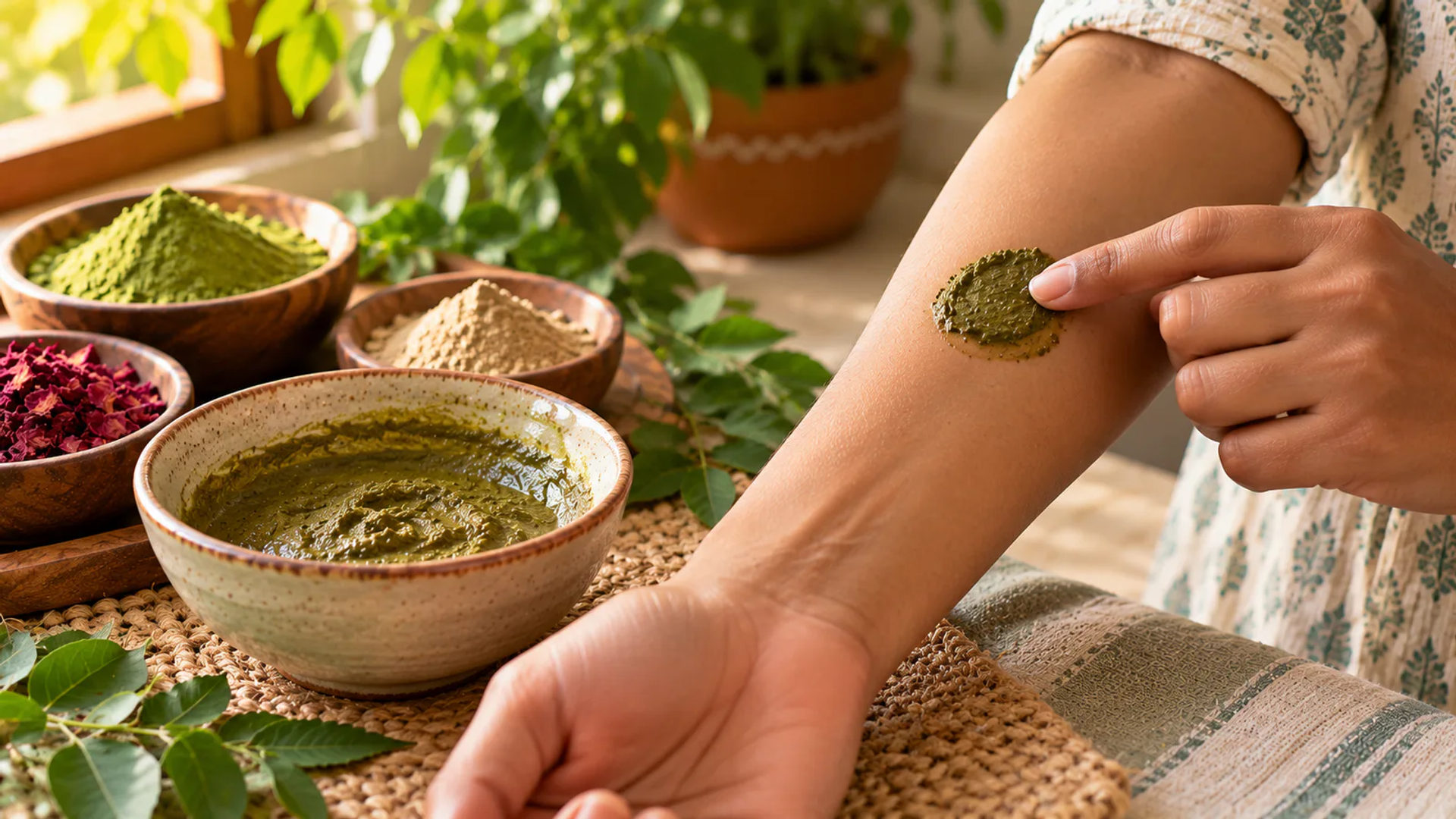
Four steps, done once per powder. The reason single-ingredient powders are worth buying is the same reason a patch test is straightforward.
4 min read
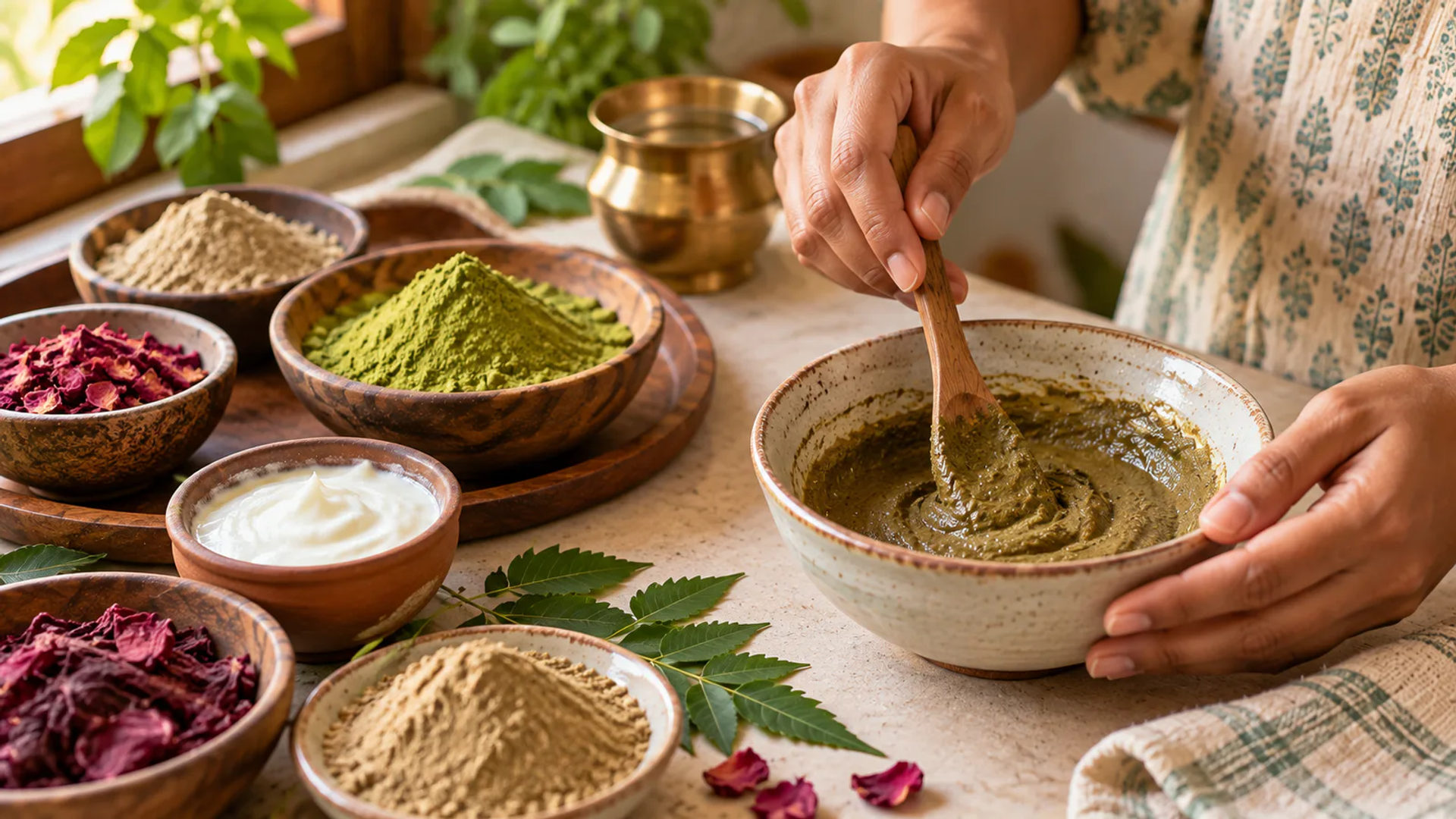
Rose petal, a base and a patch test. The five steps that turn a jar of powder into a pack you can actually use.
5 min read