
27% off
Hair Care
Bhringraj Powder
Single ingredientNo fillers or blendsShips in 7 days
Pure bhringraj leaf powder for traditional hair and scalp-care preparations.
100 g
₹159MRP ₹21927% off
Karisalankanni (Tamil) · Eclipta prostrata
What is Bhringraj?
Bhringraj is the herb Eclipta prostrata, known in Tamil as karisalankanni. The dried whole herb is finely ground into bhringraj powder, a popular ingredient in traditional Indian hair-care preparations.
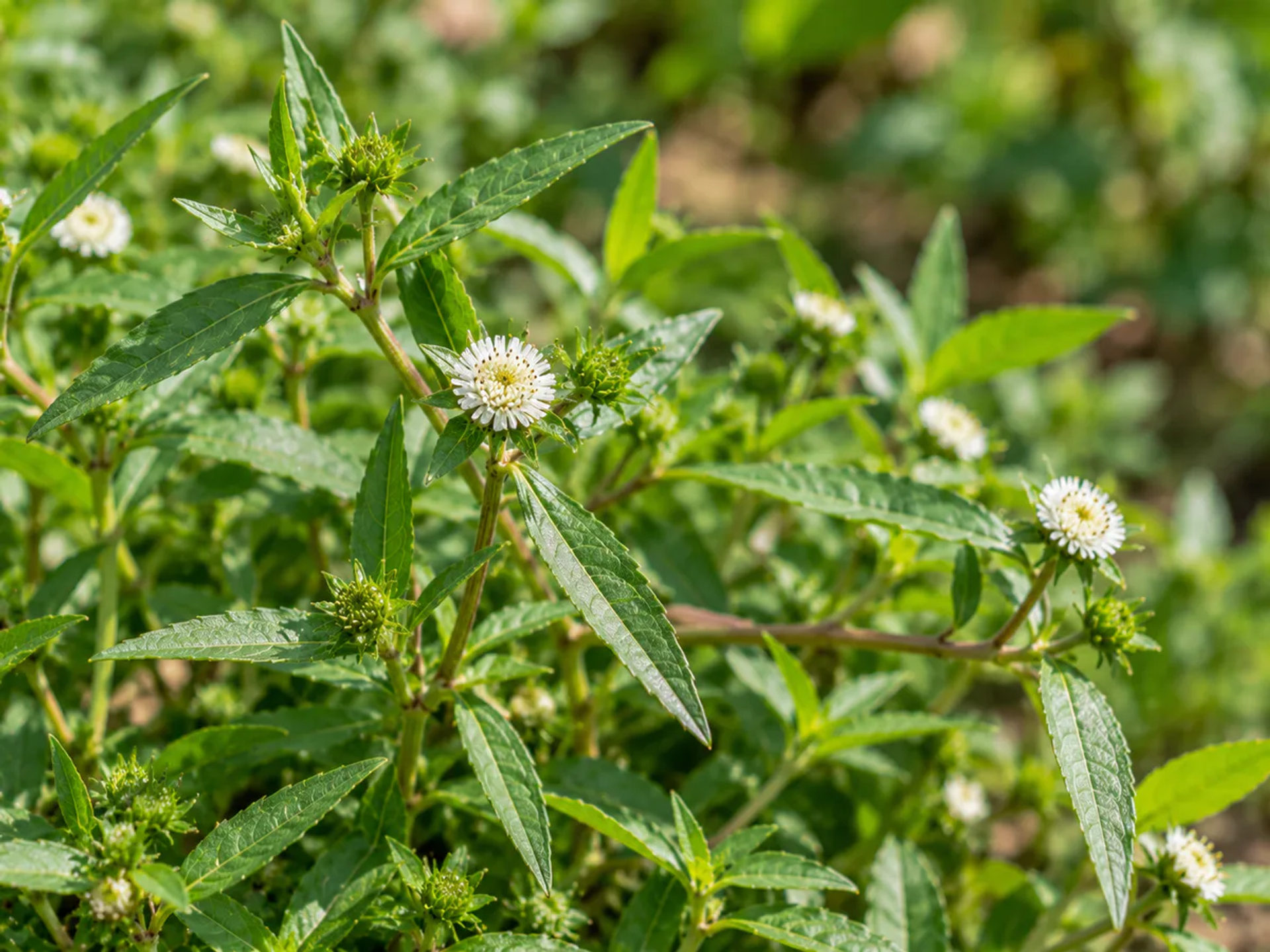
Bhringraj — karisalankanni in Tamil — is a low, sprawling herb found in damp ground and paddy margins. The whole herb is dried and ground, producing a dark green powder long used in Indian hair preparations.
Bhringraj is a popular ingredient in traditional Indian hair-care preparations. The powder is mixed with water, aloe vera gel or another suitable base to make a hair pack.
Walk the bund of almost any flooded rice paddy in Tamil Nadu after the monsoon and you will step over karisalankanni without a second glance. It grows low, spreads sideways rather than up, and roots wherever a stem happens to touch wet mud. Botanically this is Eclipta prostrata, and in the language of weed science it is exactly that: a weed, one of the most persistent volunteer plants in irrigated rice systems on more than one continent. It has no need of cultivation, no preference for good soil, and no particular charm at first glance.
Yet somewhere between the paddy margin and the Sanskrit medical treatises, this scruffy little plant picked up a name that translates, roughly, as king or lord of hair. That gap — between a plant agronomists list as a nuisance and a plant that carries a royal title in classical texts — is the most interesting thing about Bhringraj, and it is worth sitting with rather than rushing past. This piece is about the plant itself: what it is botanically, where it grows, why it is named the way it is, how the raw herb becomes the dark green powder in a packet of THENVANAM Bhringraj Powder, and the naming confusions worth knowing before you buy the wrong thing under the right name.
Eclipta prostrata belongs to Asteraceae, the daisy or sunflower family — the same family as marigolds, chrysanthemums, and the common lawn daisy. This is one of the more genuinely surprising facts about the plant, because nothing about its sprawling, hairy, purplish stems and narrow serrated leaves says "daisy" at first sight. You have to look at the flower heads to see the family resemblance, and even then you may need to crouch down, since each head is barely six to eight millimetres across — smaller than a fingernail.
Those tiny heads carry a ring of white ray florets around a denser cluster of disc florets at the centre, the same basic architecture as a garden daisy, just built at a fraction of the scale and without the showiness. The stems are round, often tinged purple, and covered in fine white hairs; the leaves sit opposite each other along the stem, lance-shaped and roughly toothed at the edges. It is an unassuming plant to look at directly in a field — which is part of why so many people who have used the powder for years have never actually stopped to identify the living plant it came from.
The Sanskrit name Bhringaraja is generally read as "king of hair" or "lord of hair" — bhringa relating to hair and raja meaning king or ruler. It is a striking name, and it is worth explaining as exactly what it is: a naming fact, inherited from classical usage, not a description of a measured effect. The name tells you how the plant was regarded historically in a particular textual tradition; it does not, on its own, tell you what the plant does.
Eclipta prostrata under its various historical names appears in classical Ayurvedic literature, including the Charaka Samhita, one of the foundational compiled texts of the Ayurvedic corpus, alongside the Sushruta Samhita. Both are historical documents, assembled and redacted over centuries, and their inclusion of a plant is a fact about textual history — a record of how a substance was categorised and discussed by a particular medical tradition at a particular point in time. We mention this because it is a genuinely interesting piece of the plant's cultural biography, and because Bhringraj's name and textual pedigree are precisely why it became, and remains, one of the most recognisable ingredients in Indian hair-oil and hair-pack formulations — a popularity that is a matter of documented tradition and market history, not something this page is in a position to evaluate.
It is tempting to think of Bhringraj as a distinctly Indian or South Asian plant, given how strongly it is associated with Indian hair-care tradition. Botanically, this undersells it considerably. Eclipta prostrata is a cosmopolitan species, recorded across the tropical and warm temperate belts of Asia, Africa, the Americas, and Australia. Botanical databases and regional floras list it from the southeastern United States to Southeast Asia to sub-Saharan Africa, and it turns up as an introduced or naturalised weed in places far from any of those regions too. Taxonomic and distributional records even point toward the Americas as a plausible original range for the species, with its present near-global spread the result of long-distance dispersal — helped, as with many wetland weeds, by seeds that travel well in mud, in irrigation water, and stuck to birds and livestock.
What ties all of these disparate locations together is not climate exactly but a very specific kind of disturbed, damp ground: paddy bunds, drainage ditches, canal banks, the soggy margins of ponds and lake shores, and any patch of waste ground that stays wet longer than its neighbours. In other words, Eclipta prostrata is a specialist not in any one country but in a habitat type — the kind of marginal, waterlogged, human-disturbed ground that exists wherever people grow irrigated crops or dig a canal. That it should be so common in Tamil Nadu's paddy tracts, then, is not a coincidence of geography but simply what the plant does everywhere it finds the right conditions.
The taxonomy here carries a genuinely practical wrinkle worth knowing before you buy any "bhringraj" product, powder or oil. Eclipta alba, the name many older herbal texts and even some current product labels still use, is now treated by botanists as a synonym of Eclipta prostrata — the same plant under an earlier name, not a separate species. If you see Eclipta alba on an old reference or a label, you are reading about the same herb described elsewhere as Eclipta prostrata.
The confusion that actually matters for buyers is a different one: Wedelia calendulacea, a related but distinct plant in the same daisy family, is also sold and referred to as "bhringraj" in parts of the herbal trade, distinguished informally in some regional usage as "yellow bhangra" against Eclipta's "white bhangra" — a nod to the colour of their respective flower heads. Wedelia calendulacea has yellow ray florets rather than white, and it is not botanically identical to Eclipta prostrata, whatever a bag labelled "bhringraj" happens to say. This kind of common-name overlap is not unusual in the Indian herb trade, where a single vernacular name can cover more than one botanical species depending on the region and the seller, and it is one of the more useful things to actually check — by botanical name, not just the Tamil, Hindi, or Sanskrit name on the packet — before assuming two products are the same herb.
THENVANAM's Bhringraj Powder starts as the whole plant — stem, leaf, and flower head together, which is standard practice for this herb, since the traditional preparations that use it call for the whole herb rather than an isolated leaf or root fraction. After harvest, the plant is cleaned of soil and debris, since it grows so close to wet ground that a fair amount clings to it, and then dried. Drying is the step that does the real transformation: fresh Eclipta is a somewhat unremarkable green, but as it loses moisture the leaf and stem tissue darkens, which is why the finished powder comes out a deep, almost black-green rather than the pale green of many other leaf powders.
Once fully dried, the material is ground to a fine, uniform powder and passed through sieving to remove any coarser stem fragments or fibrous bits that did not break down evenly. The result is a powder fine enough to wet into a smooth paste without gritty residue — a practical requirement, since it is almost always used mixed with a liquid or gel base rather than dry. The colour of the finished powder is, incidentally, one of the more reliable rough indicators of how the drying was handled: a powder that has gone grey-green or has a dusty, faded look has typically been overexposed to light or heat somewhere in the process.
A plant this widespread across the subcontinent inevitably picks up a different name in nearly every language it grows within reach of. In Tamil it is karisalankanni, the name under which it is most recognised in Tamil Nadu's own herbal and hair-care traditions. In Hindi and several other North Indian languages it appears as bhangra or bhringraj itself; in Sanskrit texts, bhringaraja or the shortened kesharaja. Regional and vernacular lists also record names such as garuga in parts of the Deccan and various Bengali and Malayalam equivalents, reflecting just how far the plant's common range, and its use, extends across Indian linguistic zones.
This proliferation of names is itself part of why the Eclipta-versus-Wedelia mix-up persists in trade: a name like "bhangra" was never tied to a single Linnaean binomial in everyday usage the way a botanist would want it to be, and a plant this common, growing this widely, was always going to accumulate names faster than any single naming authority could standardise them.
Dried leaf and herb powders are hygroscopic by nature — they pull moisture out of the air given the chance, and a botanical powder as finely ground as this one has a lot of surface area with which to do it. The basic storage rules that apply to most dried herb powders apply here without much modification: keep it in an airtight container, keep that container somewhere cool and dry, and keep it out of direct sunlight. Light and ambient moisture are the two things most likely to dull the colour and coarsen the texture of the powder over time, well before any question of the powder actually spoiling.
A resealable pouch or a small jar with a tight lid, kept in a cupboard rather than on an open shelf near a stove or a sunny window, is generally enough. If you notice the powder clumping, that is usually a sign moisture has gotten in — worth a look at the seal rather than a reason for concern about the herb itself. As with any dried botanical, use a dry spoon to portion it out, since introducing moisture into the container each time you use it is the single most common way a good batch of powder ages faster than it should.
Part of why Eclipta prostrata is such a persistent presence in paddy fields is how quickly it completes its life cycle. It germinates readily in wet, disturbed soil, flowers within weeks of establishing, and sets seed fast enough to complete several generations within a single growing season under the right conditions — the same biological trait that makes it, from an agronomist's point of view, a genuinely difficult weed to eradicate once it takes hold in a paddy system. Its stems root wherever a node touches damp ground, so a single plant can spread sideways across a bund faster than most people would expect from something so unassuming to look at.
None of this fast, opportunistic growth habit has any bearing on how the dried herb is processed into powder — it simply explains why a plant this ordinary to farmers has never needed to be deliberately cultivated at any scale to remain available, in paddy country, essentially year-round.
Karisalankanni.
The whole herb is dried and finely ground.
Botanical nomenclature and regional plant names — THENVANAM Editorial
Botanical names are given in the accepted binomial form; Tamil and other regional names are recorded as they are used in South Indian households.
Documented South Indian household practice — THENVANAM Editorial
Descriptions of traditional use record how an ingredient has customarily been prepared and used. They are not statements of clinical effect and should not be read as health advice.
Hair Care
Single ingredientNo fillers or blendsShips in 7 days
Pure bhringraj leaf powder for traditional hair and scalp-care preparations.
100 g

Sembaruthi, karisalankanni, sangu poo. Many of these ingredients are better known by their Tamil names than their English ones — and one has no English name at all.
5 min read
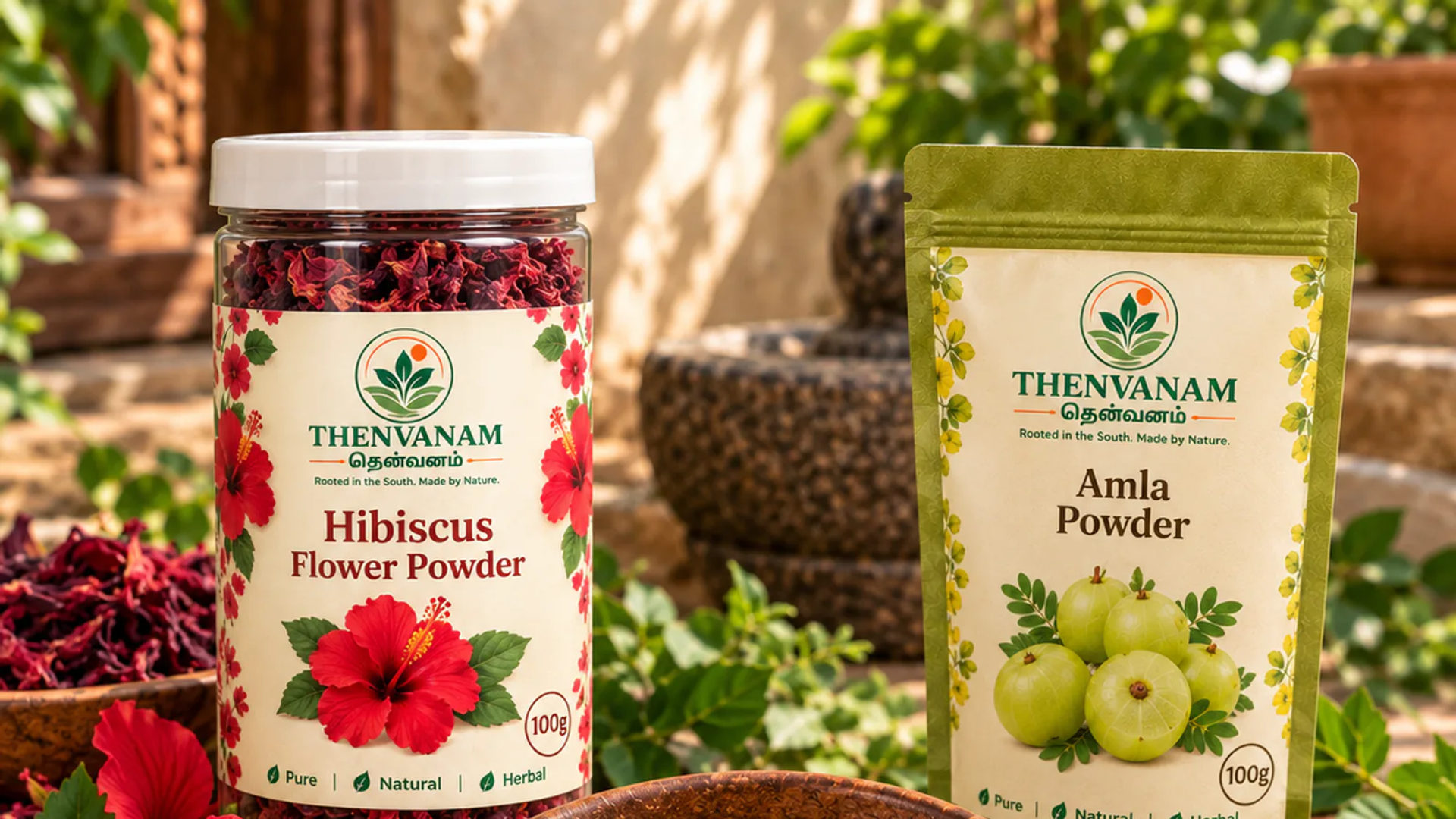
Sembaruthi and nellikai, the two powders most often mixed into a traditional hair pack, with aloe vera gel as the base.
3 min read