
26% off
Hair & Skin Care
Hibiscus Flower Powder
Single ingredientNo fillers or blendsShips in 7 days
Finely powdered hibiscus flowers traditionally used in natural hair and beauty routines.
100 g
₹169MRP ₹22926% off

Sembaruthi (Tamil) · Hibiscus rosa-sinensis
What is Hibiscus?
Hibiscus is a flowering shrub known in Tamil as sembaruthi. Its flowers are dried and finely milled into hibiscus flower powder, traditionally used in natural hair and beauty routines.

The red hibiscus — sembaruthi — grows in courtyards across Tamil Nadu, and its flowers have a long-standing place in home hair routines. Dried and milled, the petals produce a soft powder that swells slightly when mixed with water.
Hibiscus flowers have traditionally been used in home hair preparations across South India, mixed with water, aloe vera gel or yogurt into a hair mask.
Say "hibiscus" to most people outside India and they will picture a sour red drink — karkade, agua de jamaica, or a tea-shop hibiscus infusion. That plant is Hibiscus sabdariffa, and it is a genuinely different crop from the one growing in a Chennai courtyard. What THENVANAM sources and mills is Hibiscus rosa-sinensis, the flower Tamil homes call sembaruthi. The two share a genus and a family (Malvaceae, the mallow family, alongside okra and cotton) but very little else in daily use.
The distinction is structural, not just cultural. Hibiscus sabdariffa is grown for its calyx — the fleshy, tart sepal casing that swells around the seed pod after the flower itself has already dropped. That calyx is what gets dried and steeped for karkade. Hibiscus rosa-sinensis, by contrast, is grown for the flower itself: the broad, showy petals that most people would draw if asked to sketch "a hibiscus." Its calyx is thin and unremarkable — nobody dries it for tea, and it was never bred to be palatable in the way sabdariffa's calyx was selected to be tart and thick.
There is a second layer to the confusion, and it is one botanists themselves argue about. Hibiscus rosa-sinensis, as currently circumscribed, is not a clean wild species at all. Kew's Plants of the World Online lists it with a multiplication sign — Hibiscus × rosa-sinensis — flagging it as a cultigen, a hybrid formula (H. cooperi × H. kaute in one accepted treatment) that arose under cultivation rather than in a forest somewhere. After centuries of gardeners crossing red-flowered hibiscus types across China, India, and the Pacific, the plants sold today under the name "rosa-sinensis" are, in the words of hibiscus taxonomists, usually several generations removed from any single wild ancestor. It is less a species in the strict sense and more a very old, very stable garden hybrid that has been propagated by cutting for so long across so many households that it behaves like one.
The Latin epithet rosa-sinensis translates to "rose of China," and it is a fairly confident misnomer. The plant is not a rose (roses are Rosaceae; hibiscus is Malvaceae), and current native-range data from Kew and GBIF point to Vanuatu, not China, as the origin of the wild ancestors behind the hybrid. What is true is that Chinese gardeners were cultivating and selecting red double-flowered hibiscus forms in temple and palace gardens for a very long time, and it was largely through Chinese and Southeast Asian trade routes that European botanists first encountered the plant in the 18th century — which is presumably how the "sinensis" stuck. Carl Linnaeus formally named it in 1753, working from cultivated material rather than a wild-collected specimen, which is part of why its true origin took botanists so long to sort out.
From there the plant's spread was fast and deliberate. It moved through Polynesia into Hawaii, where it crossed with Hawaii's own native hibiscus species. The first Hawaiian hibiscus show was held in 1914, triggering a boom in named cultivars, and in 1923 the territory adopted hibiscus as its official flower — by then a plant with ancestry spanning the Pacific, India, and China, wearing a Chinese name it never really earned.
In Tamil, the plant carries a far more literal label. Sembaruthi breaks down as sem (red) and paruthi (cotton plant) — "red cotton flower," a reasonable description from a culture that had cotton, another Malvaceae relative, growing in the same soil. Malayalam calls it chembaruthi, a close cousin of the Tamil word; Kannada markets know it as dasavala; Hindi speakers call it gudhal; and in Sanskrit ritual texts it appears as japakusuma. One flower, one hybrid lineage, half a dozen regional names — each one describing the same red bloom from a slightly different angle.
Walk through almost any older residential street in Tamil Nadu and you will find a sembaruthi bush by the gate or in a corner of the courtyard, usually red-flowered, usually kept low and bushy through regular cutting for the day's puja. This is not incidental gardening. The red hibiscus has a specific, well-documented place in South Indian domestic and temple worship, offered fresh at the start of most days rather than kept as a decorative shrub that happens to also get picked occasionally.
Two associations recur across devotional literature and temple practice. The flower is closely tied to Ganesha worship — in some regional traditions it is described as his preferred offering — and separately to the worship of Kali and other fierce goddess forms, where the flower's intense red is read as matching the goddess's own iconography. Because the plant flowers daily and prolifically, and because a fresh bloom is considered preferable to a wilted one in most ritual contexts, households growing their own bush solved a practical problem: a reliable, self-renewing daily supply of an offering flower, without depending on a flower market. That practical rhythm — grow it by the door, pick it each morning, offer it, and let the rest of the bush keep flowering — is arguably as responsible for the sembaruthi bush's ubiquity in South Indian homes as any single festival is.
None of this is a claim about what the flower does for the person offering it; it is simply a documented pattern of use, consistent enough across Tamil, Malayalam, Kannada, and Hindi-speaking regions that garland-makers and temple flower vendors treat red hibiscus as a standing, non-seasonal stock item, unlike jasmine or lotus which are far more tied to specific months or occasions.
One of the odder footnotes in this flower's history is that in parts of India and, earlier, in China, Hibiscus rosa-sinensis was pressed into service as a shoe polish. The common English name "shoeblack plant" is not decorative — nineteenth-century horticultural writing describes rubbing the crushed petals, anthers and pollen removed, directly onto leather, where the flower's natural mucilage dried to a glossy, blacking-like finish. Older Chinese accounts describe a similar use of the petal juice as a black hair dye and as a component of mascara-like cosmetics, exploiting the same mucilaginous, slightly staining sap that modern phytochemical papers now describe more precisely: a gum built from rhamnose, galactose, and galacturonic and glucuronic acids, the same broad family of plant mucilages found in okra and other mallows.
That mucilage is the physical reason the dried, milled petal behaves the way it does once it meets water — it is a gum-forming plant tissue, not a starch, so it does not dissolve so much as slowly hydrate and thicken, giving the paste its characteristic slight swell and slip rather than a gritty or chalky texture. It is the same underlying chemistry, put to a cosmetic-adjacent use for polishing leather in one century and, in a South Indian kitchen, for mixing into a hair mask in another — two very different applications of one unglamorous plant gum.
Hibiscus rosa-sinensis is not the only member of its genus doing double duty in gardens and kitchens worldwide, and the family resemblance causes its own small confusions. Hibiscus syriacus — rose of Sharon, a hardy temperate shrub grown widely in Korea, where it is the national flower — looks superficially similar in flower shape but is a completely different, cold-tolerant species suited to climates the tropical rosa-sinensis could never survive. Hibiscus mutabilis, the "Confederate rose" or changeable rose-mallow, produces flowers that shift from white to pink to deep red over a single day, a trait sometimes wrongly attributed to rosa-sinensis by people encountering both in the same nursery catalogue. Then there is the wider Malvaceae family itself: cotton (Gossypium), okra (Abelmoschus esculentus), and the hibiscus genus all sit close together on the same branch, which is part of why the mucilage that makes okra "sticky" and the mucilage in a hibiscus petal paste are chemically close cousins rather than a coincidence.
Within rosa-sinensis specifically, more than two centuries of selective breeding — accelerated hugely after that 1914 Hawaiian show — have produced thousands of named cultivars in single, double, and ruffled forms, in colours running from white through yellow and orange to the deep red most associated with Tamil courtyards and temple offerings. THENVANAM works with the classic single red-flowered form, the one most consistently grown as a hedge or courtyard bush across Tamil Nadu rather than the newer ornamental hybrids bred primarily for flower size and show-bench colour.
The flowers used for THENVANAM's powder are picked at the point they fully open — a hibiscus bloom on this species is famously short-lived, typically lasting a single day before wilting, so timing the harvest is less about ripeness and more about picking on the day the bud has opened. This is very different from a crop like sabdariffa, where the useful part (the calyx) is harvested later, after the petals have already fallen away.
Once picked, the petals are separated and spread out to dry, away from direct sun in most traditional processing, since intense heat and light degrade the deep red pigment (largely anthocyanins, the same broad pigment family responsible for the red in roselle calyces, red cabbage, and grape skin) faster than shade-drying does. Fully dried petals become brittle and paper-thin, losing the vast majority of their fresh weight as water evaporates out of that same mucilaginous tissue. They are then milled to a fine powder — a process that has to contend with the fibrous, slightly gummy nature of the dried petal, which does not pulverise as cleanly as a drier leaf or root would. The result is a soft, matte, deep maroon-to-brick-red powder, distinctly different in feel from a leaf powder: finer strands of fibre are more likely to be visible under close inspection, a giveaway that the material started as a thin petal rather than a thicker leaf.
The hair mask this powder is milled for was never a formal, written formulation — it belongs to the same category of home practice as turmeric in cooking or neem leaves strung over a doorway: regionally consistent, largely undocumented in any single authoritative text, passed from a mother's or grandmother's kitchen rather than from a pharmacopoeia. Across Tamil Nadu, Kerala, and Andhra Pradesh, the base recipe recurs with small variations — hibiscus petal powder mixed with plain water into a paste, or with yogurt, or with aloe vera gel scraped fresh from a home-grown plant, or occasionally with a beaten egg or a few drops of coconut oil folded in for consistency.
What varies between households is largely texture preference rather than ingredient logic: yogurt makes a thicker, tangier paste that clings longer; aloe gel makes a slippier, more elastic one; water alone gives the most direct sense of how the powder itself behaves, swelling gently as the mucilage in the dried petal rehydrates. None of these combinations were standardized in any clinical or industrial sense — they persisted because they were simple, used what was already in the kitchen or garden, and were easy to repeat weekly without needing to buy anything beyond the flower itself.
Dried botanical powders lose quality primarily through three routes — moisture, light, and air — and hibiscus petal powder, given how much mucilage and pigment it carries even in dried form, is no exception. Moisture is the most immediate risk: the same gum that gives the fresh paste its texture will happily reabsorb ambient humidity in a poorly sealed container, causing the powder to clump and, in time, mould. An airtight container is the single most useful safeguard, more so than any other single step.
Light and heat are the slower threats, working mainly on the anthocyanin pigments that give the powder its colour — the same class of compound that fades in cut flowers left on a windowsill. Storing the container in a cool, dark cupboard rather than on an open shelf near a window keeps the colour, and by extension the material, closer to its milled state for longer. Keeping the powder away from strong-smelling neighbours in the pantry is also worth doing, since a dried petal powder with this much surface area and porosity absorbs ambient odours more readily than most people expect. Standard practice for any dried botanical — dry hands, dry spoon, airtight lid, cool dark storage — applies here without modification.
Is the hibiscus in this powder the same plant as hibiscus tea? No. This is the single most common mix-up with this ingredient, and it runs in both directions — people occasionally expect this powder to taste or steep like karkade, and separately, people buying hibiscus tea sometimes assume it comes from the ornamental garden flower. THENVANAM's powder is milled from Hibiscus rosa-sinensis petals; hibiscus tea is made from Hibiscus sabdariffa calyces. Different part of a related but distinct plant, different processing, different end use.
Is "rosa-sinensis" actually from China, then? Not by current evidence. The name reflects where the plant was extensively cultivated and first documented by European botanists, not where it originated — Vanuatu and the wider Pacific are the better-supported native range for its wild ancestors.
Why does the powder feel slightly slippery or thick when mixed with water, rather than just turning into a flat paste like a leaf powder would? That texture comes from the plant's natural mucilage — the same gum family responsible for okra's characteristic sliminess — rehydrating once water is added. It is a structural property of the dried petal, not an additive.
Finally, why is a hibiscus bush at the gate of so many South Indian homes rather than tucked away in a back garden? Partly ritual convenience — a plant that flowers daily and is picked fresh each morning for puja works best close to the house — and partly habit passed down over generations, the same quiet domestication that turned a Pacific-hybrid ornamental into one of the most recognisable flowers of a Tamil courtyard.
Sembaruthi.
The flower. THENVANAM Hibiscus Flower Powder is 100% hibiscus flowers.
Botanical nomenclature and regional plant names — THENVANAM Editorial
Botanical names are given in the accepted binomial form; Tamil and other regional names are recorded as they are used in South Indian households.
Documented South Indian household practice — THENVANAM Editorial
Descriptions of traditional use record how an ingredient has customarily been prepared and used. They are not statements of clinical effect and should not be read as health advice.
Hair & Skin Care
Single ingredientNo fillers or blendsShips in 7 days
Finely powdered hibiscus flowers traditionally used in natural hair and beauty routines.
100 g

Every traditional pack recipe ends the same way — "mix with a suitable natural base". Which base you choose changes the consistency, the drying time and how the pack comes off.
5 min read

Sembaruthi, karisalankanni, sangu poo. Many of these ingredients are better known by their Tamil names than their English ones — and one has no English name at all.
5 min read
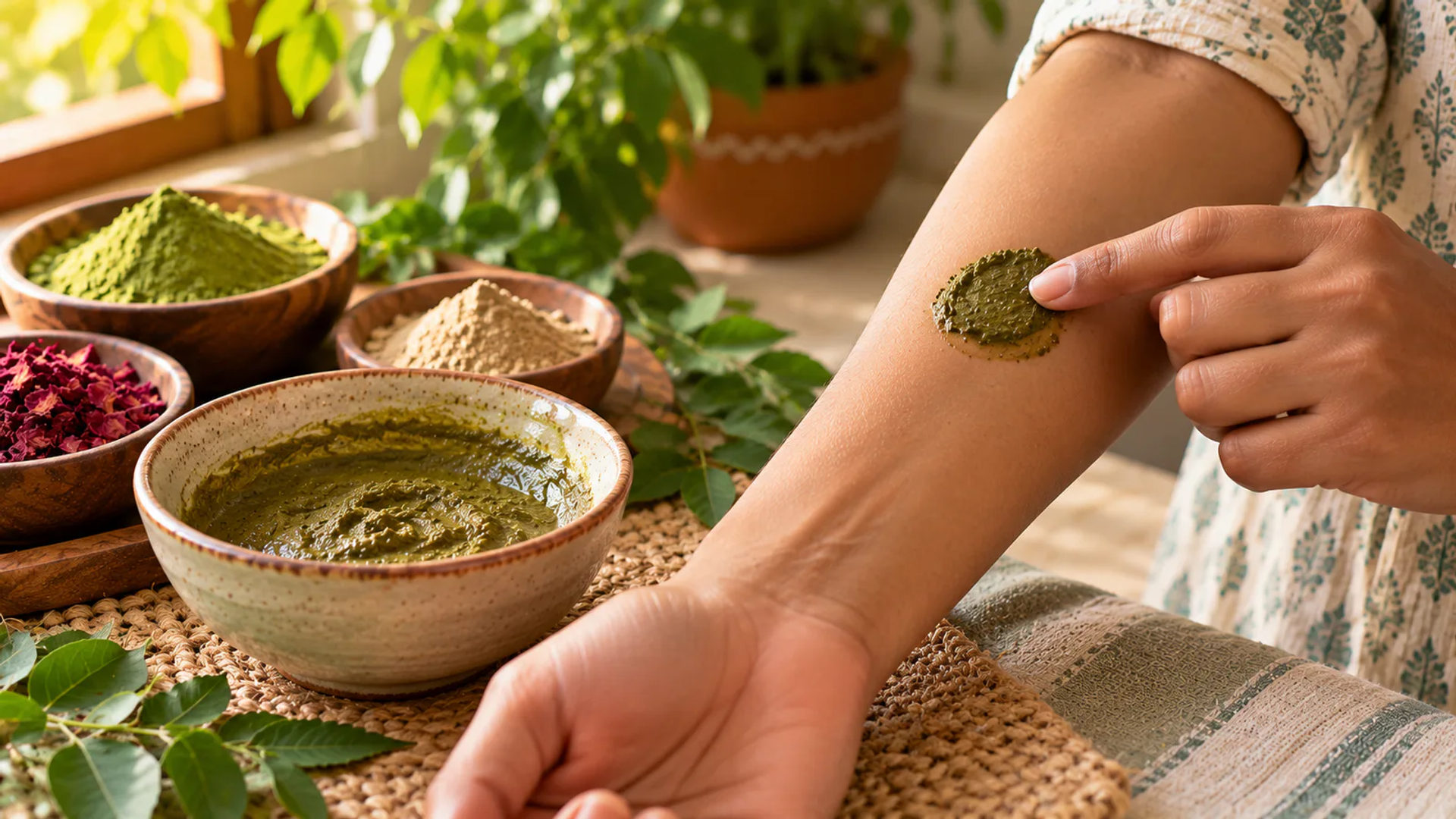
Four steps, done once per powder. The reason single-ingredient powders are worth buying is the same reason a patch test is straightforward.
4 min read

Coastal South India is not a kind place to store a dry powder. A few small habits make the difference between a pack that lasts and one that clumps in a month.
4 min read
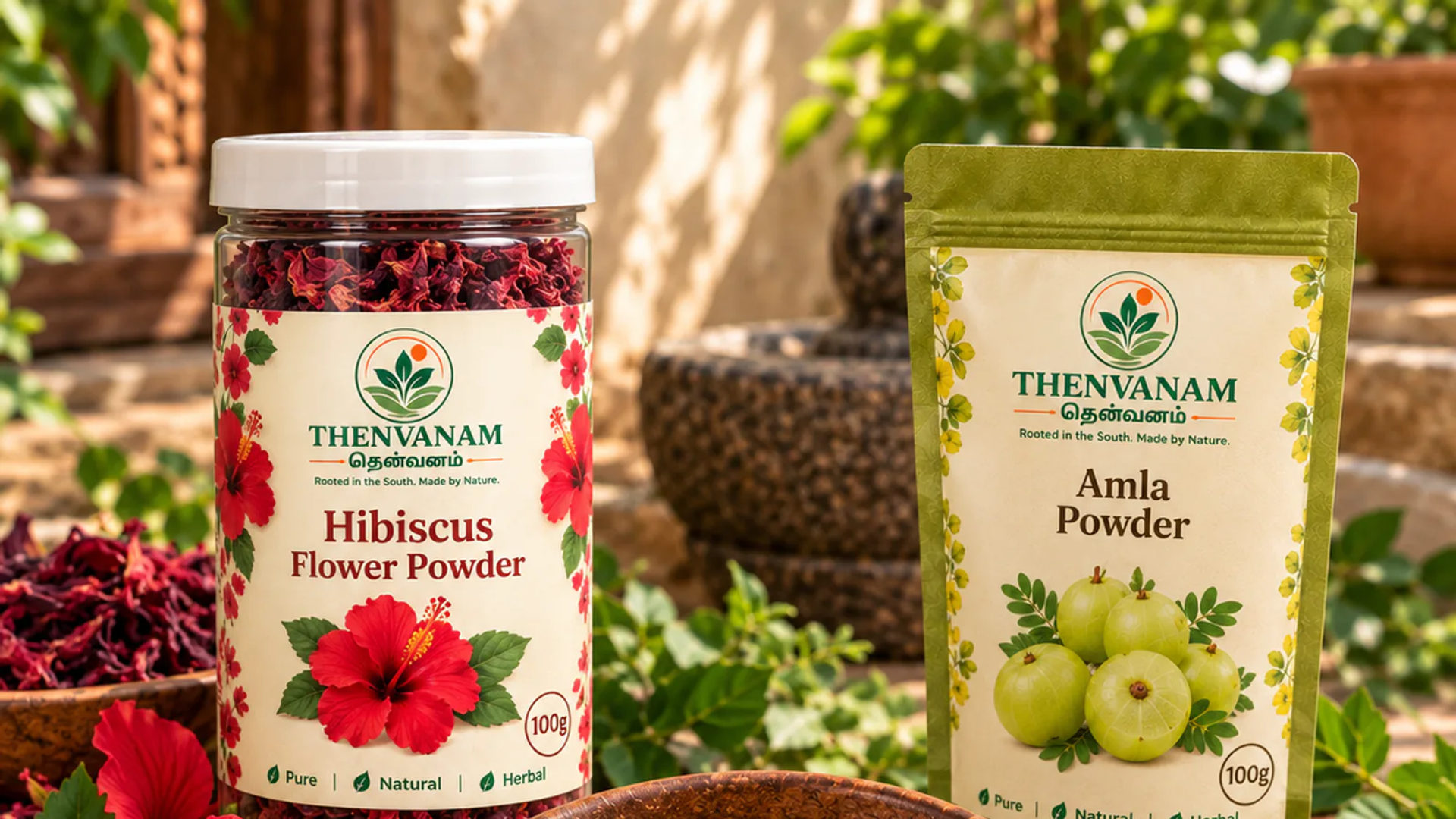
Sembaruthi and nellikai, the two powders most often mixed into a traditional hair pack, with aloe vera gel as the base.
3 min read

Between the plant and the pack there are two steps that decide almost everything about the finished powder. Neither is complicated. Both are easy to get wrong.
5 min read