
25% off
Wellness
Amla Powder
Single ingredientNo fillers or blendsShips in 7 days
Finely ground amla fruit powder made from naturally dried Indian gooseberries.
100 g
₹149MRP ₹19925% off

Nellikai (Tamil) · Phyllanthus emblica
What is Amla?
Amla is the fruit of Phyllanthus emblica, the Indian gooseberry, called nellikai in Tamil. The dried fruit is finely ground into amla powder, used in traditional food and personal-care practices.

Amla is the Indian gooseberry — a small, hard, pale-green fruit with a sharp taste that turns sweet on the second sip of water. Known as nellikai in Tamil, it is dried and milled into one of the most widely used powders in the Indian household.
Amla has long been valued in Indian traditional food and personal-care practices. In powder form it is most often mixed with water or a suitable hair-care base and applied as a hair pack.
Botanically, amla is Phyllanthus emblica, a deciduous tree in the family Phyllanthaceae, order Malpighiales — placing it, taxonomically, closer to cassava and the tung-oil tree than to any true berry. Older texts and some pharmacognosy papers still list it under its earlier name, Emblica officinalis, and both names turn up on ingredient labels, seed packets and in older Ayurvedic literature interchangeably. Kew's Plants of the World Online records its native range across tropical and subtropical Asia: Assam, Bangladesh, Sri Lanka, Myanmar, Thailand, Laos, Vietnam, southern China, Malaya, Java and the Lesser Sunda Islands, alongside peninsular and eastern India. It is a modest-sized tree, rarely more than 8 to 18 metres tall, with a crooked trunk, greyish flaking bark, and feathery, closely set leaves that give the whole canopy a light, almost fern-like silhouette from a distance.
The fruit itself is unremarkable to look at — a smooth, pale yellow-green sphere, roughly the size of a large marble, with faint vertical lines dividing it into six segments and a hard, angular stone at the centre holding the seeds. It ripens through the cooler months, which is why amla has traditionally been a winter and early-spring fruit across most of northern and central India, harvested from around October through February depending on region and cultivar. In Tamil Nadu and other parts of the south, where THENVANAM sources it, the tree fruits somewhat differently across microclimates, and orchards will often stagger harvest across a few weeks rather than picking everything at once.
The Tamil word nellikai and the more widely used Hindi/Sanskrit-derived amla (from amalaki) both point to a fruit that has never been treated as ordinary produce in India. The tree has its own day on the Hindu calendar — Amalaki Ekadashi, falling in the lunar month of Phalguna, usually in February or March, just ahead of Holi. Devotees traditionally worship the amla tree itself on this day, tying a thread around the trunk, sitting beneath it to eat or pray, and treating the tree, rather than an idol, as the object of the ritual. Wikipedia and several temple calendars note that the occasion is dedicated to Vishnu, with tradition holding that both Vishnu and Lakshmi are said to reside within the tree — a detail worth knowing not as a claim about the fruit's properties but as a fact about how deeply the plant is woven into ritual life, independent of anything written about it in a kitchen or a clinic.
Classical Ayurvedic texts — the Charaka Samhita and the Sushruta Samhita among them — list amalaki extensively as one of three fruits making up triphala, a combination that recurs throughout that literature. This is worth noting purely as a historical and textual fact: these are centuries-old formulations documented in Sanskrit medical texts, not verified outcomes, and nothing about their inclusion in old texts is a claim about what a home cook or a hair-pack user should expect today. What is safe to say is that few fruits in the Indian subcontinent carry this density of textual, ritual and culinary reference simultaneously — most ingredients get one lane; amla got three.
Fresh amla doesn't keep. It bruises and spoils within days of picking, which is precisely why drying has always been the default way to hold onto a winter harvest through the rest of the year. Traditional processing starts with washing and sorting the fruit, then either slicing it or leaving smaller fruits whole, and spreading it out to dry in the sun over anywhere from ten days to two weeks, depending on humidity and how thick the pieces are cut. As the fruit loses moisture it darkens dramatically — the pale green skin turns a deep brown, almost black, and the flesh shrinks and toughens around the central stone. Some processors now use mechanical dehydrators to shorten this window and get more consistent batches, but the underlying transformation is the same: water leaves, and what's left concentrates.
Once fully dried, the fruit is deseeded (the hard central stone doesn't grind well and is typically discarded or used separately) and milled into a fine powder. The stone itself, incidentally, is where the tree gets its Sanskrit epithet — amalaki loosely translates to "sour" — and it's also the part that traditional processors are most careful to remove completely, since even small fragments left in a batch will show up as grit in the final powder. A well-made amla powder should be uniformly fine, without visible woody flecks, and a shade of khaki-brown to greyish-green depending on how the fruit was dried and how finely it was sieved.
Fresh amla's sharpness has made it a fixture of pickling traditions across the country, and each region treats it a little differently. In much of north and central India — Madhya Pradesh in particular, where amla is grown in significant quantity — the fruit is candied into murabba: pricked all over, blanched to soften it, then simmered slowly in sugar syrup over several days until the sourness mellows into something closer to a sweet-tart preserve, eaten by the spoonful or alongside paratha. In Maharashtra the same preparation goes by avalaacha muraba in Marathi. Punjab and Haryana lean on it heavily through winter in pickles and chutneys built around mustard oil, fenugreek and red chilli. In the south, amla appears in thokku-style pickles, in rasam, and occasionally grated fresh into chutneys alongside coconut and green chilli — a much sharper, more savoury register than the syrupy north Indian murabba.
The fruit's best-known large-scale culinary and pharmaceutical use, though, is as the primary ingredient in chyawanprash — a dense, dark, spoonable jam built on cooked amla pulp bound with ghee, sugar or jaggery, honey and a long list of other dried herbs and spices. Commercial production of chyawanprash by companies such as Dabur has made it one of the most recognisable amla-based products on Indian shelves, alongside amla candy, amla juice concentrates and amla-based pickles sold at a much smaller, regional scale. Powdered amla, by contrast, has stayed closer to home use — mixed into water, batters, or a hair-care base rather than sold as a finished snack, which is largely why THENVANAM sells it as a plain milled powder rather than a prepared product.
Amla's common English name, Indian gooseberry, is one of those translations that raises more questions than it answers. True gooseberries belong to the genus Ribes — the same genus as currants — a group of small shrubs native mostly to temperate Europe, Asia and North America, bearing soft, translucent berries that range from tart to genuinely sweet and are eaten raw, stewed, or baked into pies and jams. Phyllanthus emblica shares none of that lineage. The resemblance that earned amla its English nickname is really just visual — a small, round, pale-green fruit — and the resemblance stops almost immediately once you bite into either one. Ribes gooseberries are soft-skinned and juicy from the first bite; amla is firm, almost crunchy in texture, and its flavour arrives in stages rather than all at once.
This naming overlap causes genuine confusion for people encountering amla for the first time outside India, who sometimes expect something closer to the European fruit and are caught off guard by how astringent and fibrous fresh amla actually is. It's worth knowing, if only so the powder's taste doesn't come as a surprise: this is not a gooseberry in any botanical sense, just a fruit that happened to remind someone, at some point in translation, of one.
Amla's flavour is genuinely unusual and worth describing carefully, because it doesn't sit still. The first taste is sharply sour, almost puckering, followed closely by a bitter, astringent note that coats the tongue — this is the tannin content at work, a family of polyphenolic compounds (gallic acid, ellagic acid, emblicanin A and B among others) that give the fruit its characteristic dryness in the mouth, the same category of compound responsible for the astringency of strong tea or an unripe persimmon. Then, distinctively, a few seconds after swallowing, or especially after a sip of water, a subtle sweetness surfaces at the back of the taste — a sequence Indian food writers and Ayurvedic texts alike have long singled out as the fruit's signature: sour, then bitter and astringent, then sweet. Drying concentrates all of this. What was a bright, watery sourness in the fresh fruit becomes a denser, more mineral, almost smoky sourness in the dried powder, with the astringency correspondingly more pronounced.
This is also why amla powder rarely appears alone in a recipe or a hair pack — it's usually blended with something to round off that sharp edge, whether that's water, oil, yogurt, or other powders. Its intensity is the point rather than a flaw to work around, but it does mean a small quantity goes further than most people expect on a first try.
Dried amla powder is hygroscopic — like most finely milled dried fruit, it pulls moisture out of the air readily, and once it does, both its texture and its colour shift for the worse, clumping and darkening faster than it would in a sealed, dry environment. The standard, well-documented handling for any dried fruit powder applies here without needing any special claims about amla specifically: keep it in an airtight container, store it somewhere cool and dark rather than near a stove or a sunlit windowsill, and always use a dry spoon. Moisture introduced by a wet spoon or an improperly sealed lid is the single most common way a good batch of dried powder turns patchy or musty well before it otherwise would.
If you notice the powder caking into small lumps, that's usually a sign of ambient humidity getting in rather than anything wrong with how it was milled — sieving it lightly before use generally restores it to a workable texture. A resealable pouch or a small glass jar with a tight lid both work; what matters more than the container material is how consistently it's closed and how far it sits from steam, direct sun, or a damp kitchen shelf.
Is amla the same thing as gooseberry? Only in name. As covered above, it's unrelated botanically to the Ribes gooseberries sold in Western markets, and the two don't taste, feel or cook alike.
Is amla powder the same as amla juice concentrate or dried amla candy? No — they're different processing paths from the same fruit. Powder is the whole dried fruit, deseeded and milled fine, with nothing added or extracted. Juice concentrate is pressed and reduced; candy (murabba) is cooked in sugar syrup; chyawanprash is a compounded jam with many other ingredients beyond amla. Each has a different texture, sweetness level and shelf character because each has gone through a different process, not because one is a "purer" version of another.
Why does dried amla look so much darker than the fresh fruit? Because drying — whether by sun or dehydrator — drives off water and concentrates the fruit's natural pigments and tannins, the same basic browning process that turns a fresh apricot into a dark, wrinkled dried one. A pale-green fresh amla and a deep brown dried one are the same fruit at two different points in a straightforward physical process, not two different varieties.
Is Emblica officinalis a different plant from Phyllanthus emblica? No — it's the same species under an older botanical name. Some older Ayurvedic and pharmacological literature still uses Emblica officinalis, so both names are worth recognising if you're reading further about the plant.
Nellikai. In English it is known as the Indian gooseberry.
From dried fruit. The amla is dried and then finely ground into a smooth powder.
Botanical nomenclature and regional plant names — THENVANAM Editorial
Botanical names are given in the accepted binomial form; Tamil and other regional names are recorded as they are used in South Indian households.
Documented South Indian household practice — THENVANAM Editorial
Descriptions of traditional use record how an ingredient has customarily been prepared and used. They are not statements of clinical effect and should not be read as health advice.
Wellness
Single ingredientNo fillers or blendsShips in 7 days
Finely ground amla fruit powder made from naturally dried Indian gooseberries.
100 g

Moringa leaf powder is one of the few in the range described for food. Where to add it, when to add it, and why the timing matters.
5 min read
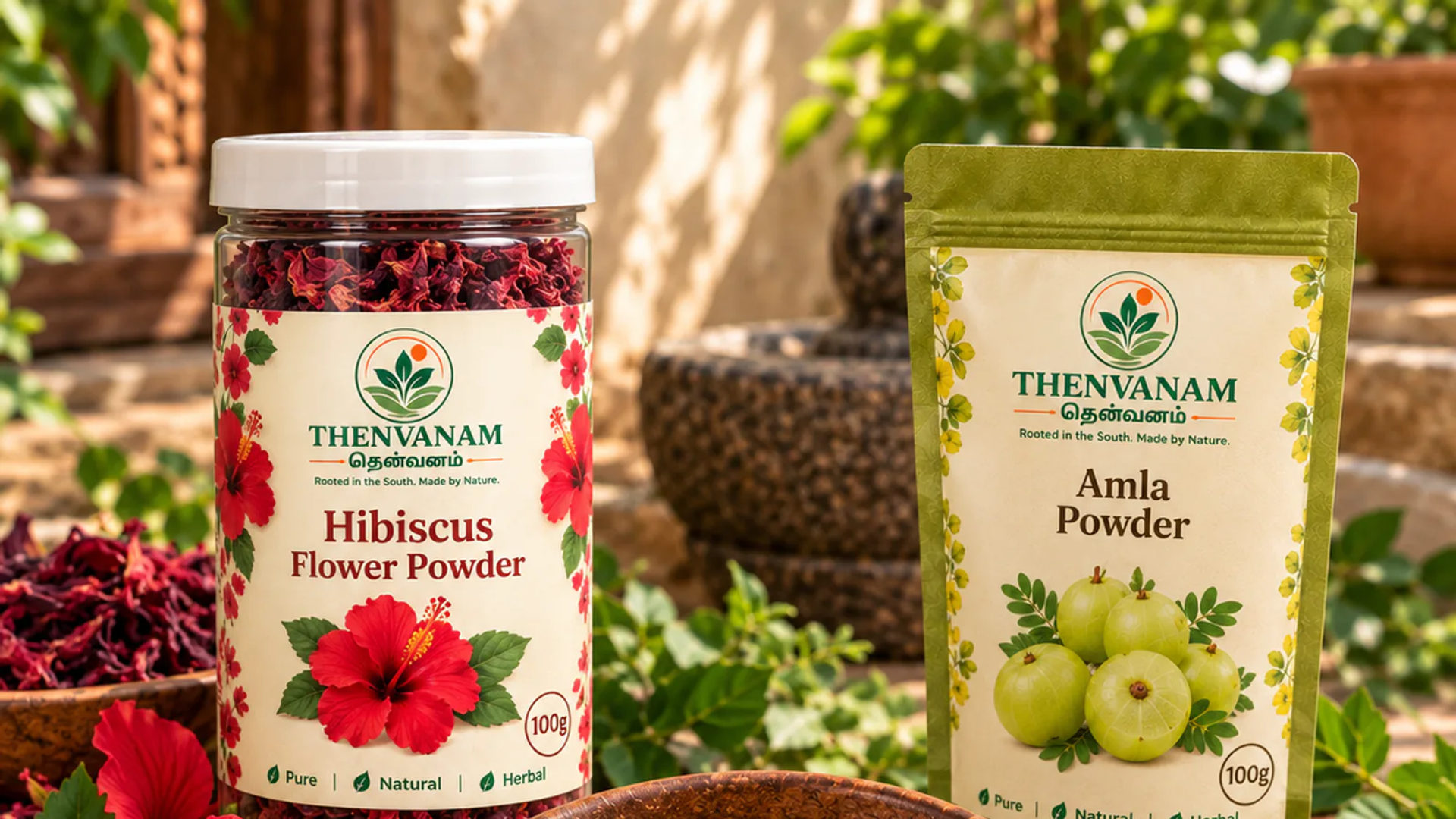
Sembaruthi and nellikai, the two powders most often mixed into a traditional hair pack, with aloe vera gel as the base.
3 min read