
25% off
Hair Care
Shikakai Powder
Single ingredientNo fillers or blendsShips in 7 days
Traditional shikakai pod powder for natural hair-care routines.
100 g
₹149MRP ₹19925% off

Sheekai (Tamil) · Acacia concinna
What is Shikakai?
Shikakai is the dried pod of Acacia concinna, ground into a powder. It has traditionally been used as a natural hair-cleansing ingredient, mixed with water into a smooth paste.

Shikakai is the pod of Acacia concinna, a climbing shrub whose name translates roughly as "fruit for hair". The dried pods are ground to a powder that mixes with water into a soft, slightly gritty paste.
Shikakai has traditionally been used as a natural hair-cleansing ingredient. The powder is mixed with water into a smooth paste, applied to wet hair and scalp, and rinsed thoroughly.
The Tamil word for the pod, sheekai, comes from cikaikkaay, and the usual gloss, "fruit for hair," is close enough to be useful but flattens a slightly more specific idea: the word points to the pod as the working part of the plant, not the leaf, not the bark, not the flower, even though all three have been used for other things in different regions. That specificity matters, because a lot of the confusion people have with shikakai powder today comes from conflating the pod with the whole plant.
The botanical name has its own small story worth knowing before it gets confusing on a label. The pod comes from a species long filed under the genus Acacia, as Acacia concinna. Acacia, however, turned out to be one of the more contested genera in the legume family, Fabaceae. Molecular studies through the 1990s and 2000s showed that "Acacia" as classically defined was not one natural group but several, and in 2011, at the International Botanical Congress in Melbourne, botanists voted to keep the name Acacia for the mostly Australian wattles and move most of the remaining species, including this one, into other genera. For shikakai, that meant a shift to Senegalia, giving the currently accepted name Senegalia rugata. Oddly, that name already existed on paper: Nathaniel Britton and Joseph Rose had proposed it back in 1928, decades before the reclassification made it standard usage. The epithet rugata is Latin for "wrinkled," a description of the dried pod's surface rather than anything to do with hair. You will still see "Acacia concinna" on older packaging, in Ayurvedic texts, and in a lot of retail copy — it is a synonym, not an error, but Senegalia rugata is the name that botanical databases like Kew's Plants of the World Online now treat as correct.
Most people picture "acacia" as a tree — flat-topped, thorny, the kind of silhouette associated with African savanna. Shikakai breaks that image. It grows as a woody, spiny climbing shrub, scrambling over fences, other trees, and scrub rather than standing alone, reaching perhaps five metres where it has something to climb on. The stems carry recurved thorns that help it hook onto whatever support it finds, and the leaves are bipinnate — each leaf divided into pairs of pairs of small leaflets, a compound structure typical of the wider mimosoid group it belongs to.
The flowers are cream to pale yellow, opening from buds that are noticeably reddish, clustered in small heads. What follows is the part that matters commercially: pods that are smooth, fleshy, and slightly plump while still on the plant, green to greenish-brown. As they ripen and dry, they contract and darken into the wrinkled, near-black, hard pods that give the species its epithet and that end up, eventually, ground into the powder in the packet. If you have only ever seen shikakai as powder, the plant itself — a thorny vine draped over a hedge, hung with these blackened pods — can be a genuine surprise.
Senegalia rugata is native to a wide arc of tropical and subtropical Asia — parts of southern China, including Guangdong and Yunnan, through the Indian subcontinent and into Southeast Asia, with recorded natural occurrence stretching to Indonesia, the Philippines, and Papua New Guinea. Within India it is common in the warm plains of the central and southern regions, which is also where its use as a hair-cleansing pod is most continuously documented.
The species has traveled well past its native range as an ornamental or hedge plant, turning up in Queensland, New Caledonia, Madagascar, Brazil, and Jamaica, and in a few of those places it has become vigorous enough to be flagged as a naturalized or even invasive climber — a reminder that a scrambling, spiny, fast-growing shrub with sticky hooked thorns is exactly the profile that succeeds a little too well once it escapes cultivation.
This is the part of the shikakai story with the most actual science behind it, and it explains something almost everyone notices the first time they use the powder: it does not foam like shampoo. The pods are rich in saponins — reported at roughly 12 percent of dry weight — along with related triterpenoid compounds such as oleanolic acid and acacic acid. Saponins are amphipathic molecules: a fat-soluble triterpenoid core fused to a water-soluble chain of sugars. That two-faced structure is precisely what makes any surfactant work, from a saponin in a plant pod to sodium lauryl sulfate in a commercial shampoo bottle — one end grabs oil and grease, the other end lets water carry it away.
Where they differ is in the details of how they behave in solution. Modern shampoo formulas use sulfates or sulfonates, which are small, highly soluble, ionic molecules that pack efficiently into stable, long-lived foam bubbles, often boosted further with dedicated foam stabilizers. Saponins are larger, more structurally varied molecules that form looser, more polydisperse micelles, so the foam they generate is coarser, less stable, and collapses faster — technically still a surfactant action, just a comparatively weak foam-generating one. That is the entire mechanism behind the paste feeling like it is "not really cleaning" to someone used to a lathering shampoo: the surface chemistry is doing similar work through a molecularly different, and much less efficient, foam-forming route.
The processing chain for shikakai is short and mechanical rather than chemical. Pods are left on the plant until they pass from the fleshy, greenish stage into the dry, wrinkled, near-black stage described earlier — this drying is what concentrates the saponins and hardens the pod into something millable. Harvested pods are then sun-dried further if needed, deseeded (the seeds themselves are not the useful part), and ground into the coarse, slightly fibrous powder familiar from the packet.
That griminess is not a processing failure. Shikakai powder is not meant to fully dissolve; when mixed with water it forms a paste that stays somewhat gritty and fibrous because the pod material includes cellulose and other plant fiber alongside the saponins. Reetha and amla powders, by contrast, behave slightly differently in water depending on how finely their respective source materials are ground — a distinction anyone who has mixed a multi-ingredient hair-wash powder at home will already have noticed.
Shikakai rarely appears alone in the historical record. Archaeological residue analysis from Banawali, a Harappan-era site in present-day Haryana dated to roughly 2750–2500 BCE, has been read as evidence of shikakai used together with soap nuts and Indian gooseberry — reetha and amla, in the vocabulary still used in Indian households today. That three-ingredient combination has had an extraordinarily long run, and it is worth being precise about why each piece is there, because they are not redundant.
Reetha is the dried fruit of Sapindus mukorossi, a tree in an entirely different family, Sapindaceae, unrelated to the legume family that shikakai belongs to. Its saponin content runs comparably high, in the range of about 10 to 11.5 percent, and because reetha saponins tend to produce a stronger, higher-volume foam than shikakai's, it is generally the more assertive cleanser of the two — described in traditional use as the deeper, less frequent wash, with shikakai as the milder, more regular one. Amla, the fruit of Phyllanthus emblica, contributes a different profile again, prized in that same tradition mainly for texture and manageability rather than cleansing strength. None of the three is a substitute for the others; the historical pairing reflects three saponin-and-tannin-bearing plant materials from three different botanical families, used together for reasons that predate any modern framework of "active ingredients."
Dried shikakai pod powder is a plant material, not a stabilized formulation, so it behaves the way most dried botanicals do: it is vulnerable to moisture, which encourages clumping and mold, and to light and heat, which degrade the saponins and other compounds over time along with the powder's color and smell. The practical response is unremarkable but effective — keep it in an airtight container, away from direct sunlight, in a cool, dry spot, and keep a dry spoon or scoop dedicated to it so moisture from wet hands or a damp scoop does not get introduced into the container between uses.
A resealable pouch or a screw-top jar both work; what matters is limiting the powder's exposure to humid air between uses far more than the specific container. If the powder has clumped hard or developed an off smell, that is moisture damage rather than a normal aging process, and it is not something to try to salvage by drying it out again.
The most common first reaction to shikakai powder is some version of "is this even working?", and it is almost always about foam. Commercial shampoo has trained several generations of hair-washing expectations around a very specific sensory cue — thick, stable, white lather — that is a formulation choice built around sulfate or sulfonate surfactants and dedicated foam boosters, not a universal requirement for a surfactant to be doing something. As covered above, shikakai's saponins are surfactants by the same basic mechanism, just structurally different ones that produce a thin, short-lived, faintly grey-green foam rather than a dense white one. That is a difference in foam chemistry, not an absence of surfactant activity.
A second common misconception is that "shikakai" refers to a single standardized extract, the way a cosmetic ingredient name might. In practice it is a dried, ground plant pod with natural variation in color, coarseness, and smell from batch to batch depending on the harvest and drying conditions — closer to a spice or a dried fruit in that sense than to a manufactured cosmetic raw material. And because the name has carried over from an older taxonomy, it is worth knowing that "Acacia concinna" and "Senegalia rugata" on two different packets can be, and usually are, the exact same pod.
The pod is what THENVANAM sells, but it is not the only part of the plant that regional traditions have made use of. The leaves of Senegalia rugata have their own separate history in South and Southeast Asian cooking, where their distinctly sour flavour — a real, documented feature of the leaf tissue — has been used to add tartness to specific regional dishes, much the way tamarind or raw mango is used elsewhere. Some folk traditions have also drawn on the plant's bark and root, though these uses are recorded far less consistently across sources than the pod's role in hair care, and none of them bear on how the pod itself is prepared or used.
It is worth being clear about the boundary: this product is the dried, ground pod, and nothing about the plant's other traditional uses changes how the pod behaves or what it is composed of. Different parts of the same climbing shrub have simply ended up serving different, mostly unconnected purposes across the regions where the plant grows wild.
The plant's recurved thorns, which let it hook onto whatever it climbs over, also make it a reasonably effective natural hedge plant where it is left to grow untended — a secondary, informal use noted in some regional accounts of the shrub, distinct from anything to do with the pod once it is harvested and dried.
The pod. It is dried and finely ground.
It is a traditional hair-cleansing ingredient rather than a modern surfactant shampoo, and it behaves differently — it does not lather in the same way.
Botanical nomenclature and regional plant names — THENVANAM Editorial
Botanical names are given in the accepted binomial form; Tamil and other regional names are recorded as they are used in South Indian households.
Documented South Indian household practice — THENVANAM Editorial
Descriptions of traditional use record how an ingredient has customarily been prepared and used. They are not statements of clinical effect and should not be read as health advice.
Hair Care
Single ingredientNo fillers or blendsShips in 7 days
Traditional shikakai pod powder for natural hair-care routines.
100 g

Two powders sit on the traditional South Indian hair-wash shelf. They come from two different plants and two different parts of them — here is how they actually differ.
4 min read
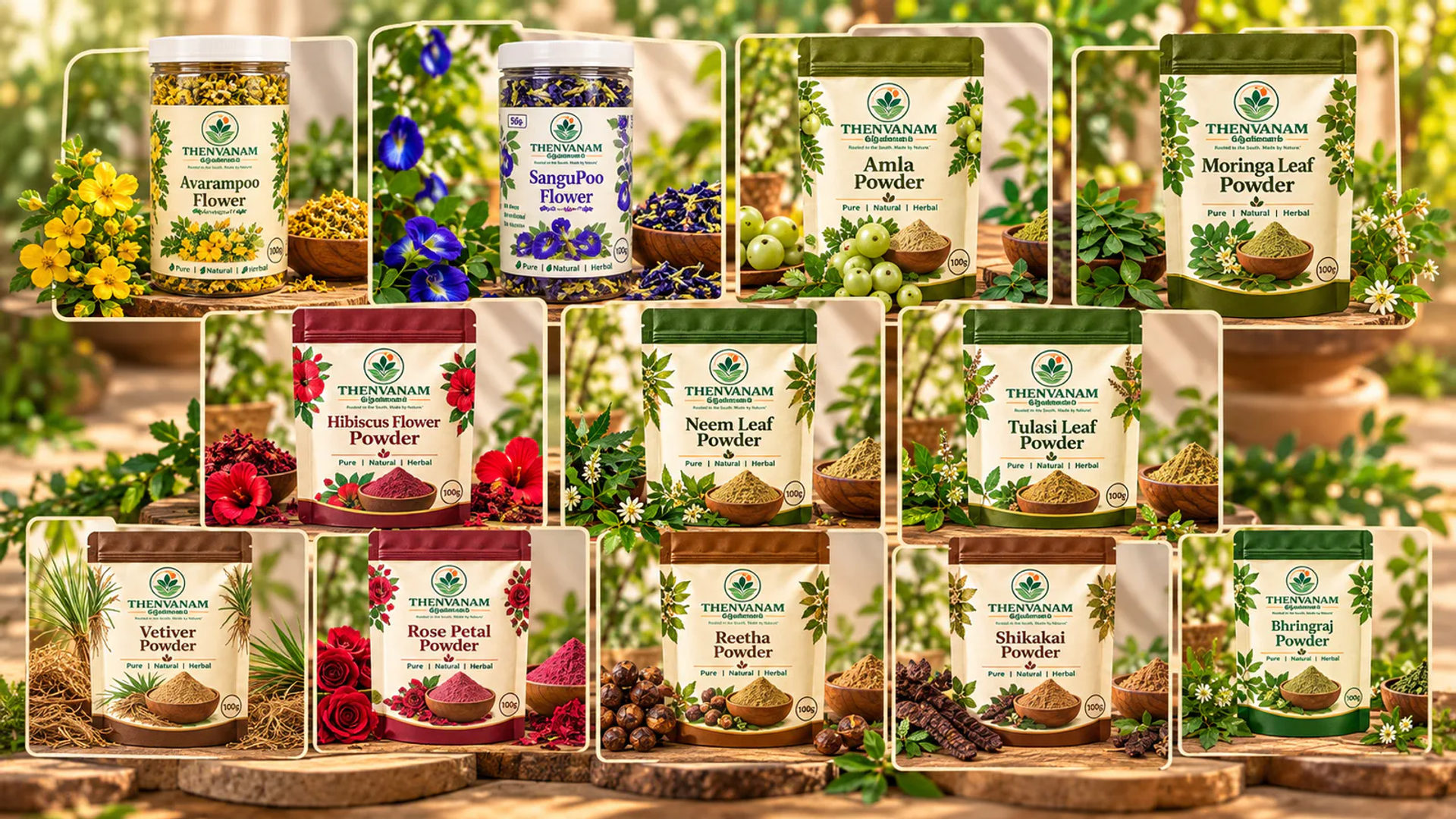
Blends are easier to sell and easier to buy. Here is the argument for the harder option.
4 min read

The standard traditional pairing — the cleansing pod and the foaming soapnut, mixed fresh with water.
3 min read
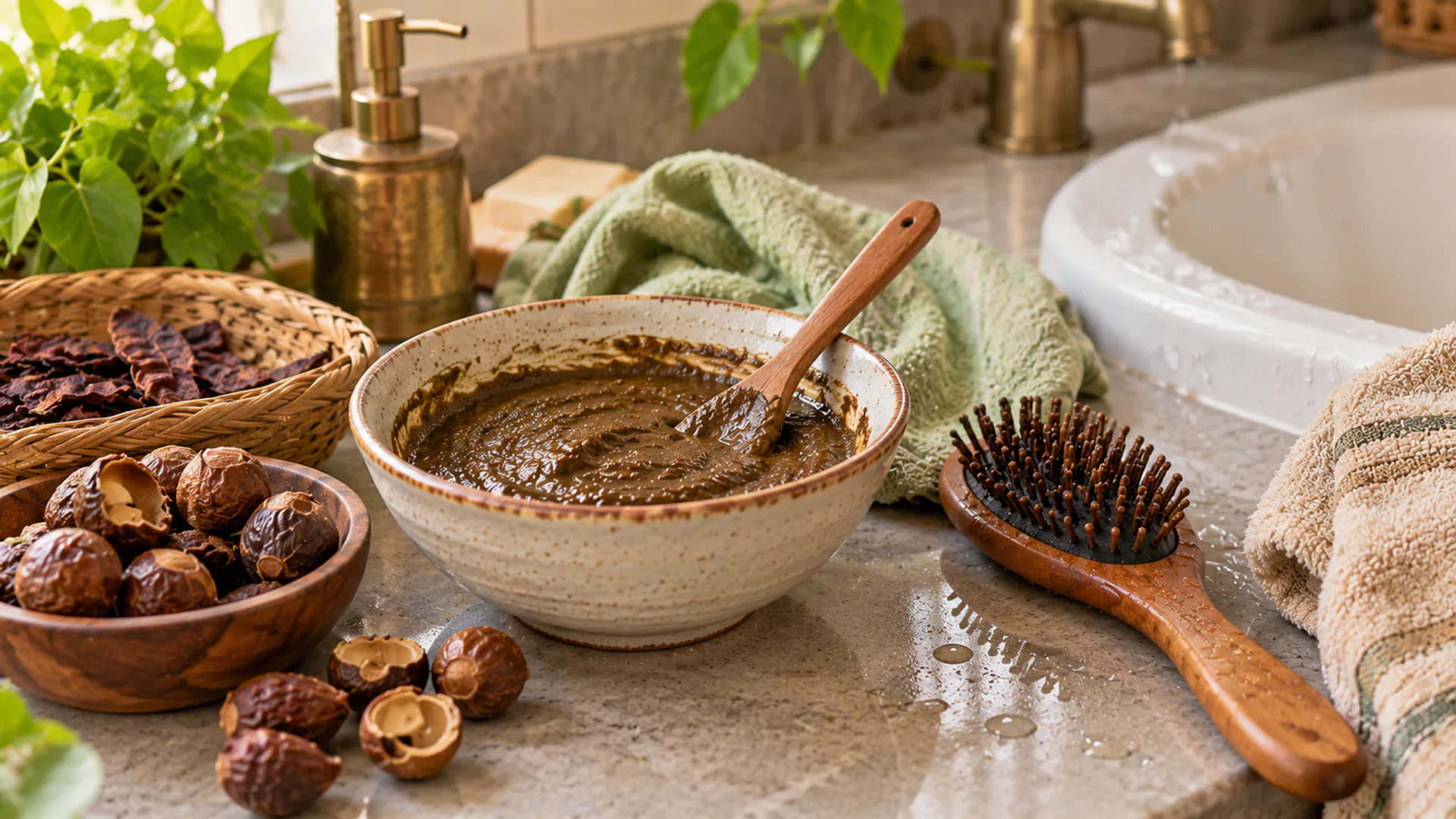
A step-by-step walk through a traditional powder hair wash — how much to mix, how to apply it and how to rinse it out properly.
6 min read