26% off
Hair Care
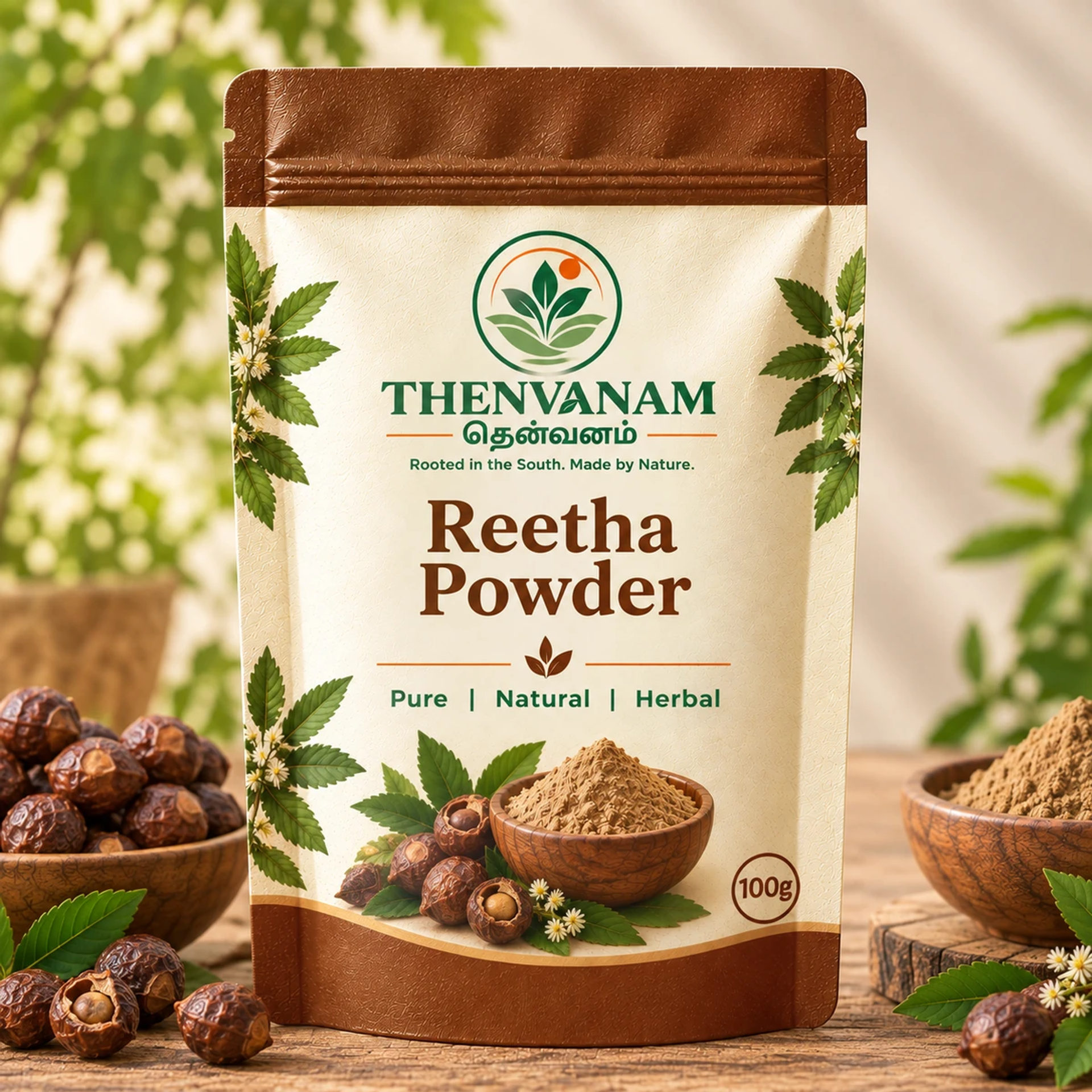
Reetha Powder
Single ingredientNo fillers or blendsShips in 7 days
Finely ground reetha powder traditionally used as a natural cleansing ingredient.
100 g
₹139MRP ₹18926% off

Poovanthi / Soapnut · Sapindus species
What is Reetha?
Reetha is the soapnut, the dried fruit of Sapindus species. It is finely powdered and has traditionally been used in natural hair cleansing and personal-care preparations.

Reetha is the soapnut — the fruit of Sapindus trees, whose shells contain natural saponins. It is the one ingredient in the traditional hair-wash shelf that genuinely foams in water.
Reetha has traditionally been used in natural hair cleansing and personal-care preparations. The powder is mixed with water into a paste or cleansing preparation, avoiding contact with the eyes.
Most things called "natural cleansers" ask you to take their word for it. Reetha does not. Drop a few pieces of the dried shell into warm water, work it with your hands for a minute, and it foams — not a wishful, marketing-copy kind of foam, but real, sustained lather that holds its shape in the bowl. That is not incidental to the fruit; it is the fruit's chemistry doing exactly what it evolved to do.
The active compounds are saponins — glycosides built from a hydrophobic steroid or triterpenoid core (the sapogenin) with one or more sugar chains hung off it. That structure gives the molecule two faces: one end happy in oil and grime, the other happy in water. Put enough of them in solution and they arrange themselves at the air-water interface, dropping surface tension and letting bubbles form and hold — the same basic physics behind any surfactant, from a bar of soap to a bottle of shampoo, except here the surfactant grew inside a fruit shell rather than a factory reactor.
What sets reetha apart from the rest of the traditional hair-wash shelf is concentration. The dried pericarp — the outer shell, which is the part that gets powdered — carries roughly 10 to 15 percent saponin by weight, and studies on extracted soapnut saponin have measured foamability rising sharply once concentration crosses the critical micelle concentration, the threshold past which the molecules start self-assembling into the structures that trap air. In practical terms: reetha does not need help lathering. Shikakai, the other saponin-bearing pod in the same tradition, works on a milder, gentler version of the same chemistry — reetha is simply the stronger foamer of the two, which is also why it was historically the ingredient reached for when something actually needed scrubbing, not just rinsing.
Reetha is not one plant — it is a name that has comfortably covered at least two different species for centuries, and that is worth untangling because it explains why bags labelled "reetha" from different sellers can look and behave a little differently.
Sapindus mukorossi is the Himalayan soapnut: a deciduous tree of the lower and mid-hills, growing up to about 1,200 metres, ranging from Himachal Pradesh and the eastern hill states across into Nepal and China. Its fruit is the larger of the two — roughly the size of a coin a little bigger than a nickel — and it carries the higher saponin load, which is a large part of why it dominates the commercial soapnut trade and why so much of the "reetha" sold across India, regardless of where the buyer lives, traces back to northern stock.
Sapindus trifoliatus is the tree South India actually grew up with: an evergreen reaching up to 25 metres, native to Tamil Nadu, Kerala, and parts of Karnataka and Maharashtra, bearing a noticeably smaller, penny-sized fruit with a comparatively lower saponin content. This is the species tied to "poovanthi" and to the older South Indian hair-wash tradition specifically — it is not simply a regional nickname for the same Himalayan fruit, but a different tree with a different native range and a different — if related — chemistry. Because the Himalayan species foams harder and travels better commercially, a good deal of what reaches South Indian households today under a "reetha" label is technically S. mukorossi rather than the trifoliatus fruit the tradition originally used. Both are legitimate reetha in the sense that both genuinely contain and release saponins; they are not the same tree, and a label that just says "Sapindus" without specifying is not being evasive so much as reflecting a genuinely blurred commercial history.
The genus name is its own small piece of etymology: Sapindus comes directly from the Latin sapo indicus — "Indian soap" — coined by European botanists who encountered the fruit's lathering property and simply described what they saw. "Soapnut" and "soapberry" in English are just translations of the same observation, made independently by people on opposite sides of the fruit's use.
The more interesting kinship, though, is taxonomic rather than linguistic. Sapindus sits in the family Sapindaceae — the soapberry family — which also contains the lychee (Litchi chinensis), the rambutan (Nephelium lappaceum), and the longan (Dimocarpus longan). It is a strange family to hold together at first glance: on one branch, sweet, juicy fruit eaten fresh by the handful; on another, a dry, leathery shell whose only edible-adjacent use is to be dissolved in water and rubbed into hair. But the family relationship is real and well documented, and it is a useful reminder that "fruit" in botany is a structural category, not a promise of flavour. The lychee's translucent flesh and the reetha shell's bitter, saponin-rich pericarp are, structurally, cousins.
The processing chain for reetha is short, which is part of why the finished powder still smells and behaves like the fruit it came from rather than like an industrial extract. Ripe fruit is harvested from the tree — mukorossi trees are typically productive from around ten years of age — and the outer shell is separated from the hard, dark seed inside. That seed is not the useful part for this purpose: it carries essentially none of the saponin content and is either discarded or, in some processing streams, kept aside for planting or seed-oil use.
The shells themselves are then sun-dried until they lose the leathery, slightly sticky texture of the fresh fruit and take on the brittle, wrinkled, deep-amber appearance most people recognise as a "soapnut." Traditional processing stops there and sells the dried shells whole, to be soaked or boiled by the household as needed. For a powder like this one, the dried shells go through an additional pounding and grinding step, reducing the brittle hulls to a coarse, fibrous powder that releases its saponins more readily in water than a whole shell would, simply because more surface area is exposed to the liquid at once.
It is worth being plain about what this process does not involve: there is no chemical extraction, no solvent isolation of "pure saponin," no standardisation to a saponin percentage. The powder is the ground fruit shell, nothing subtracted and nothing added, which also means its lathering strength will vary somewhat batch to batch depending on the fruit's species, maturity at harvest, and how it was dried — a variation the industrially-standardised liquid soapnut extracts sold for commercial use are specifically designed to eliminate.
Outside the hair-wash tradition this brand sits in, reetha has an entirely separate and well-documented modern career as an eco-friendly laundry and dish-washing agent, and the two uses rest on the identical chemistry rather than on two different properties of the fruit.
A handful of whole shells tied into a small cloth pouch and tumbled into a washing machine with hot water releases saponins into the wash cycle the same way they release into a hair-wash basin — reducing water's surface tension enough to lift oil and loose soil off fabric and hold it in suspension until the rinse cycle carries it away. This use has been documented and sold commercially as a biodegradable, low-residue alternative to synthetic detergent, particularly favoured for baby clothing and for households managing sensitive skin, precisely because the shells contain nothing but the fruit's own compounds — no synthetic fragrance, no optical brighteners, no phosphates. It is generally described as gentler and less effective on heavy grease or set-in protein stains than a commercial detergent, which tracks with what the saponin chemistry alone can and cannot do: it is a genuine surfactant, not a solvent or an enzyme.
The reason this is worth mentioning on a hair-care ingredient page is not to suggest reetha powder should go in the laundry — it should not; this pack is milled fine for a scalp preparation, not sized for a wash-bag — but because it is a clarifying data point. The same shell that foams in a hair-wash bowl is, unmodified, sturdy enough to be sold globally as a laundry product in its own right. That is a fair measure of how strong and how real the underlying surfactant chemistry actually is.
The two are often reached for together, and it is worth being precise about how they differ rather than treating them as interchangeable "natural shampoo" ingredients. Both Sapindus and shikakai (Senegalia rugata, formerly Acacia concinna) carry saponins and both were staples of the pre-industrial Indian hair-wash shelf. The difference this page can state plainly, without repeating the fuller comparison covered on shikakai's own page, is concentration and character: reetha's shell holds a denser saponin load and produces a stronger, more immediate lather, while shikakai's pod is the milder of the two. Households historically combined them for exactly that reason — one carrying more of the cleansing action, the other tempering it — rather than using either as a simple substitute for the other.
Reetha powder is a dried plant material with a genuinely reactive surface chemistry — those saponins are drawn to moisture, which is exactly what makes the powder foam so readily and exactly why damp storage is the fastest way to spoil it. Keep it in a sealed, airtight container rather than a loosely folded pouch; ambient humidity is enough to make a saponin-rich powder clump, and clumping is usually the first visible sign that moisture has gotten in.
Store it away from direct sunlight and away from heat sources — a kitchen shelf near a stove or a windowsill is a poor choice, a dry cupboard is a good one. Always use a dry spoon; introducing wet fingers or a damp scoop into the container is one of the most common ways moisture and, eventually, mould get into an otherwise well-sealed pack. Beyond that, ordinary care for any dried botanical powder applies: no invented shelf-life claims are needed here, because the same three variables — moisture, heat, light — govern how well any dried plant powder holds up, and reetha is not an exception to that rule, just a more foam-forward example of it.
On the name itself: "poovanthi" is the term this fruit carries in Tamil-speaking hair-wash tradition specifically, distinct from "reetha," which is the more northern, Hindi-derived name that has become the default commercial label across India regardless of which Sapindus species is actually inside the pack. Both names refer to the same category of fruit — the dried Sapindus shell — but they come from two separate regional traditions that used, historically, two separate species, as covered above.
On a common misconception: strong lather is not, by itself, a sign of stronger cleaning power in any absolute sense, and it is also not a sign of purity or added chemicals — it is a direct, measurable consequence of saponin concentration and the mechanics of surface tension. A batch of reetha powder that foams less vigorously than another is not necessarily weaker or adulterated; it can simply be a different Sapindus species, an earlier or later harvest, or shells that were dried under different conditions. Saponin content is known to vary with all of these factors, and none of them make the powder any less genuinely reetha.
On handling: the same surfactant action that makes saponins effective at lifting oil and grime is the reason this powder, like the shikakai pod, should be kept away from the eyes during use — it is a physical, mechanical property of a strong natural surfactant meeting a sensitive membrane, not a toxicity concern, but it is worth respecting all the same.
The fruit shell contains natural saponins, which is why it has traditionally been used as a cleansing ingredient.
Avoid contact with the eyes when using reetha powder, and rinse thoroughly after use.
Botanical nomenclature and regional plant names — THENVANAM Editorial
Botanical names are given in the accepted binomial form; Tamil and other regional names are recorded as they are used in South Indian households.
Documented South Indian household practice — THENVANAM Editorial
Descriptions of traditional use record how an ingredient has customarily been prepared and used. They are not statements of clinical effect and should not be read as health advice.
Hair Care
Single ingredientNo fillers or blendsShips in 7 days
Finely ground reetha powder traditionally used as a natural cleansing ingredient.
100 g

Two powders sit on the traditional South Indian hair-wash shelf. They come from two different plants and two different parts of them — here is how they actually differ.
4 min read
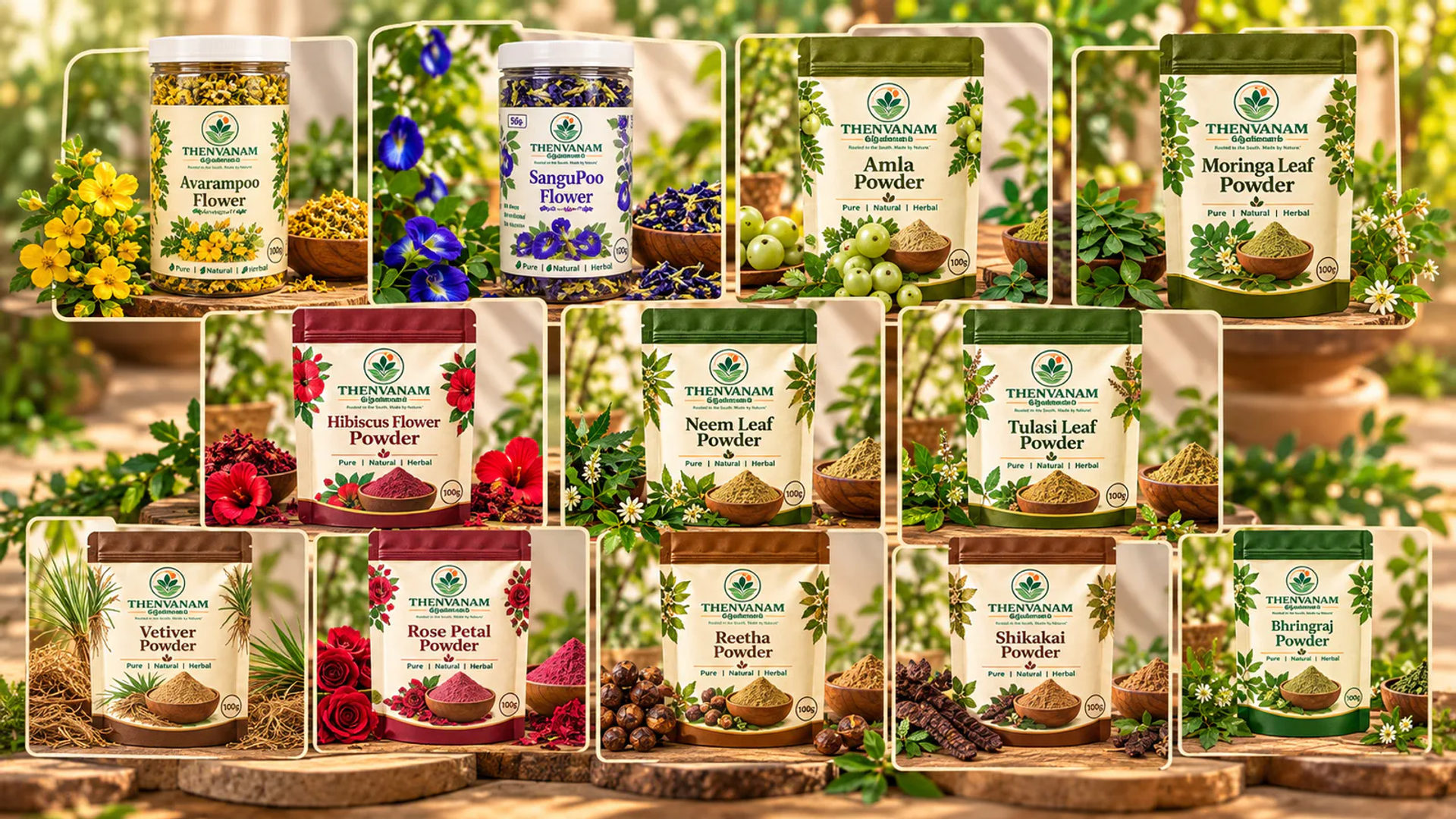
Blends are easier to sell and easier to buy. Here is the argument for the harder option.
4 min read

The standard traditional pairing — the cleansing pod and the foaming soapnut, mixed fresh with water.
3 min read
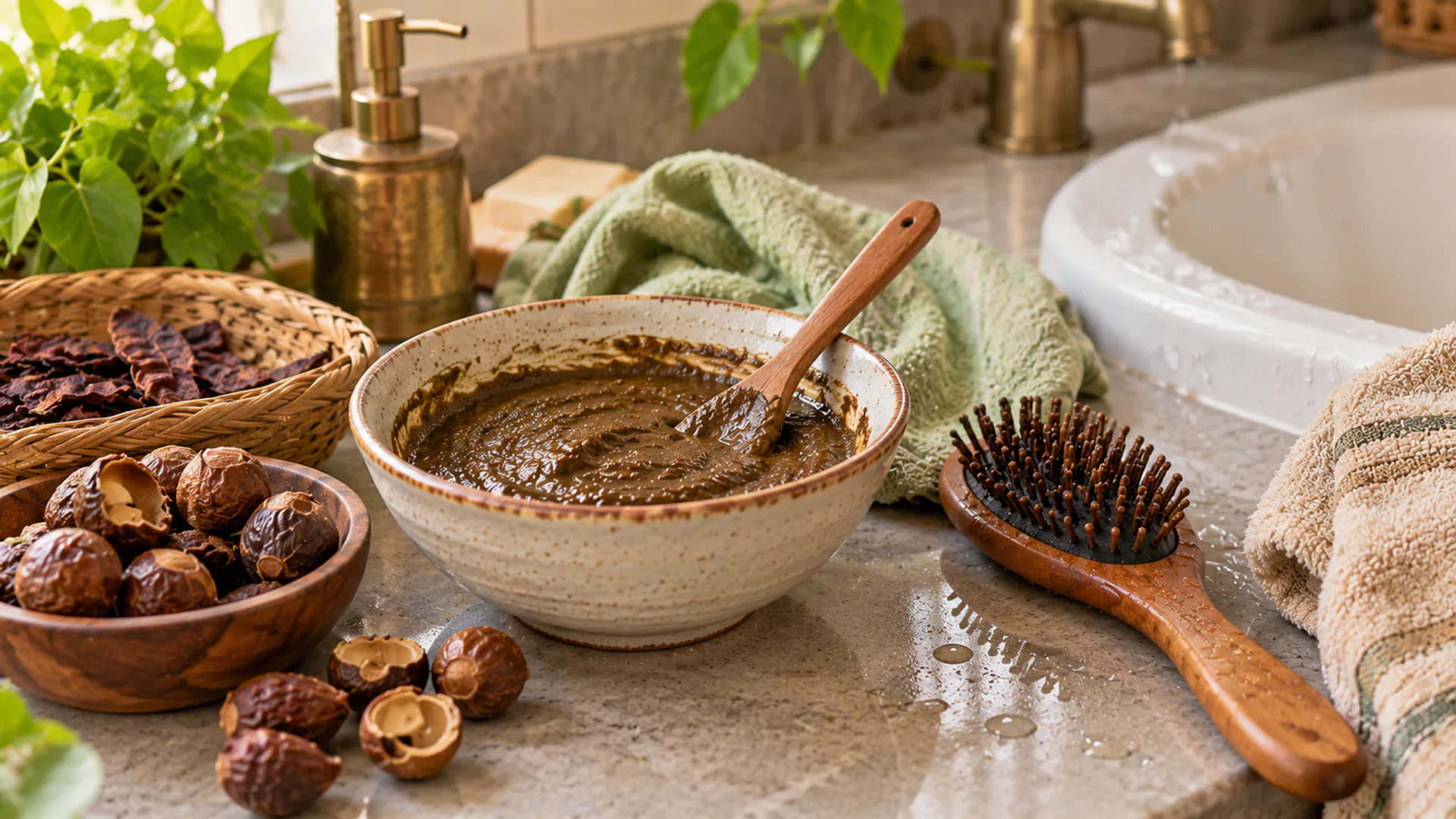
A step-by-step walk through a traditional powder hair wash — how much to mix, how to apply it and how to rinse it out properly.
6 min read